
- Fittings we install most
- 9 watt and 7 watt LED downlights
- Colour
- Warm white, cool white or daylight, set on the fitting
- Paperwork
- Certificate of Electrical Safety for the work
- Who does it
- Licensed electricians, REC 30925
Downlight work we do
The LED downlight is the single most common fitting on our lighting jobs. The work falls into four types:
- New downlights in rooms lit by one central light: kitchens, living rooms, hallways, bedrooms and bathrooms.
- Halogen to LED changeovers, where every old downlight and its transformer comes out and a sealed LED fitting goes in.
- Replacing failed LED downlights, one at a time or across a room so the colour and brightness match.
- Adding to what is there: extra downlights over a new bench, a dimmer, or splitting one switch into two.
Downlights often go in alongside other lighting. Pendants, feature lights and switches are covered on our main lighting installation page.
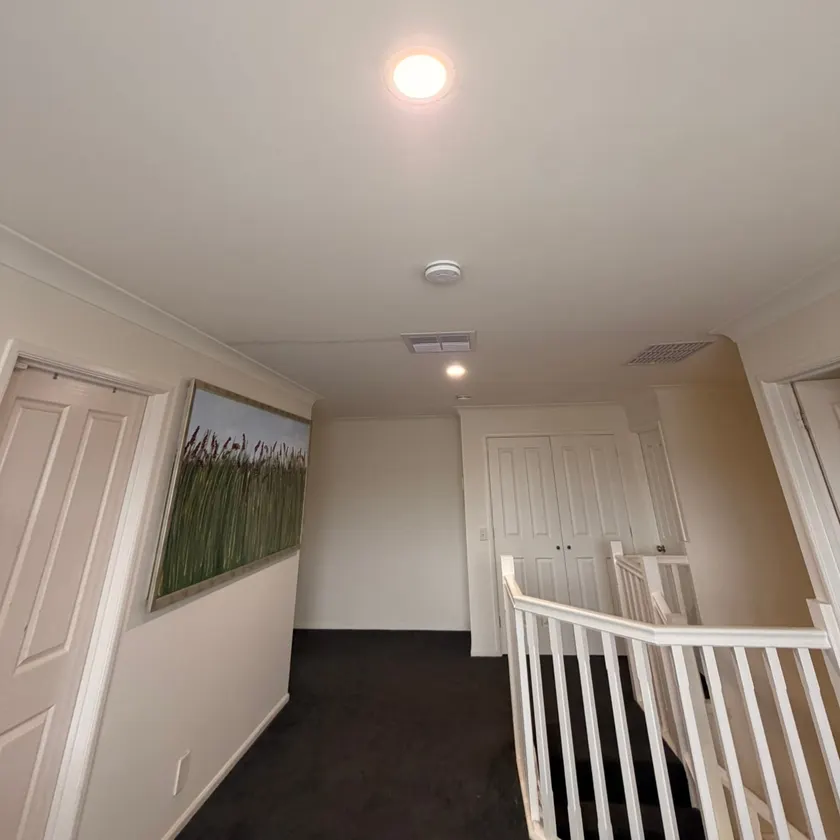
Replacing halogen downlights with LED
A halogen downlight typically drew around 50 watts, ran hot, and relied on a separate transformer sitting in the roof space. The LED fittings we install most draw 9 watts, have the driver built in and run far cooler.
We do not just swap the globe. The whole fitting and the old transformer are removed, and a new LED downlight is connected in its place. The fittings we carry suit the two most common ceiling holes, a 92 mm cut-out for the 9 watt fitting and a 72 mm cut-out for the 7 watt, so the existing holes can often be reused without patching or painting. If your current holes are an odd size, we measure first and bring a fitting that covers them.
Talk to a licensed Geelong electrician (REC 30925).
Choosing LED downlights: colour, brightness and dimming
Many of the downlights we install are tri-colour. A small switch on the back of the fitting sets the colour of the light, so you can see each option in your own room before we fix it in place.
| Setting | How it looks | Where it suits |
|---|---|---|
| Warm white (3000K) | Soft and yellow-toned | Living rooms, bedrooms, hallways |
| Cool white (4000K) | Clean and neutral | Kitchens, bathrooms, laundries, studies |
| Daylight (5700K) | Crisp and blue-toned | Garages, workshops, task areas |
Other choices we talk through with you:
- Brightness. A 9 watt fitting suits most living areas. A 7 watt fitting suits hallways, robes and smaller rooms.
- Dimming. Check the fitting is dimmable, and pair it with an LED-rated dimmer. Old halogen dimmers are the usual cause of flicker and buzz.
- Wet areas. Bathrooms, laundries and eaves call for fittings rated for moisture.
- Trim colour. White is standard. Black and brushed finishes are available.
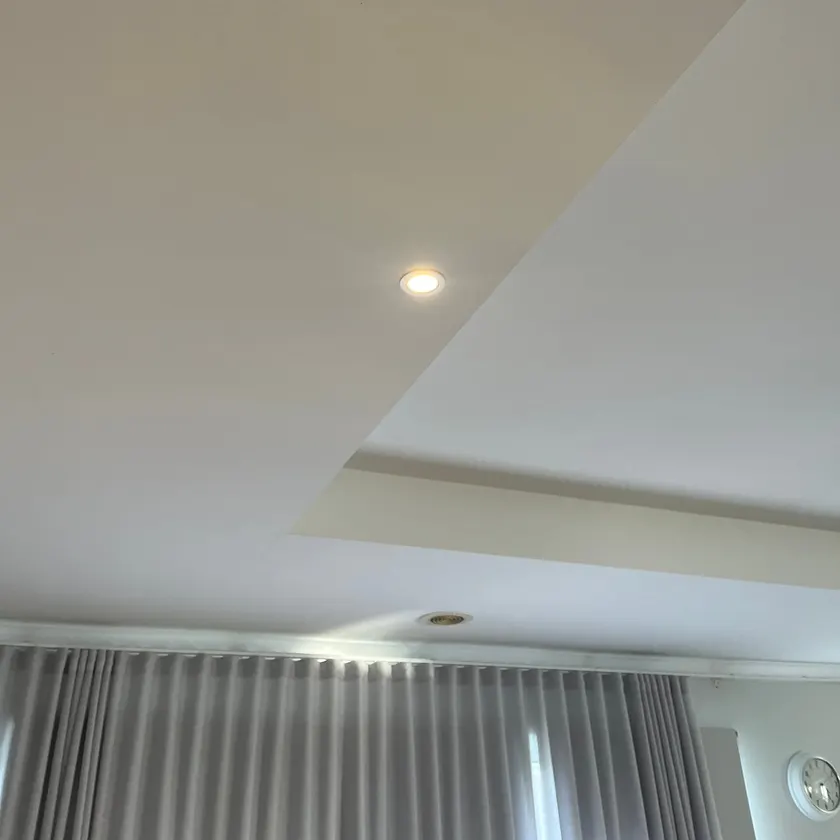
How many downlights does a room need?
There is no single number, because ceiling height, wall colour and what the room is used for all change the answer. As a starting point in a standard-height ceiling, downlights are spaced a little over a metre apart and kept back from the walls so they do not throw harsh scallops of light down the paint.
Layout matters more than count. We place lights over the front edge of kitchen benches, not behind where you stand, keep them clear of ceiling fan blades to avoid strobing, and line them up with joinery and doorways so the ceiling looks deliberate. Timber joists decide where a light can physically go, so we check the framing before marking out. If you are adding a fan to the same room, see ceiling fan installation.
How downlight installation works on the day
- Mark out. We mark every position on the ceiling and confirm the layout with you before anything is cut.
- Protect the room. Drop sheets go down and furniture is covered or moved.
- Isolate the circuit. The lighting circuit is switched off at the switchboard. The rest of the house usually stays on.
- Cut and cable. Holes are cut cleanly with a hole saw, and cable is run through the roof space from the switch to each light.
- Fit and set colour. Each fitting is connected, set to your chosen colour and clipped into the ceiling.
- Test. The circuit is tested, dimmers are adjusted and every light is checked.
- Clean up and certify. Plaster dust is vacuumed, old fittings are taken away and you receive a Certificate of Electrical Safety.
Not sure what you need? Tell us what is happening and we will talk it through.
Downlights, insulation and heat
Old halogen downlights ran hot enough that ceiling insulation had to be kept well back from them, which left a cold gap around every light. LED downlights run far cooler, and many are rated by the manufacturer to sit against or under insulation.
We check the rating marked on each fitting and install it to the manufacturer's instructions. Where the fitting allows it, insulation pushed back from the old halogens can be closed up again, which helps the house hold its heat through a Geelong winter.
Downlight problems we fix
- Flickering or buzzing, usually a dimmer that does not suit the LED, or a failing driver.
- One light out in a row, often a dead transformer or driver above the ceiling, not the globe.
- Lights that glow faintly when switched off, a common mismatch between the switch or dimmer and the LED.
- Mismatched colours after fittings have been replaced one at a time over the years.
- Scorched or brittle fittings left behind by old halogens.
- A light circuit that trips the safety switch. We trace the fault before anything is replaced.
A burning smell or heat marks around a downlight should be looked at straight away. Switch the light off and call our 24/7 emergency electrician.
Licensed and certified downlight installation
Fitting or replacing a hard-wired downlight is electrical installation work. In Victoria it must be done by a licensed electrician, and a Certificate of Electrical Safety must be provided for the job, whatever its size. You can check any contractor's registration on Energy Safe Victoria's public register. Ours is REC 30925.
Every job is backed by our lifetime workmanship warranty, more than 20 years' experience and 2,000+ five-star Google reviews.
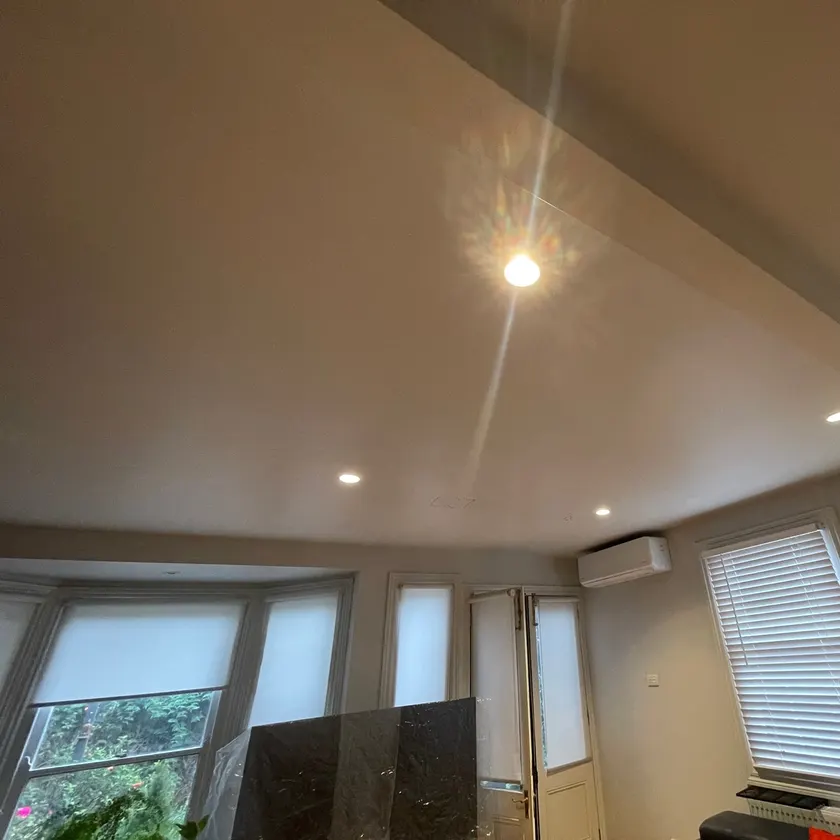
Recent downlight installation jobs around Geelong
LED downlights fitted in kitchens, living rooms and hallways by our electricians.
Frequently asked questions
Do I need an electrician to change a downlight?
To change a globe, no. To replace or add the downlight fitting itself, yes. That is electrical installation work, which in Victoria must be done by a licensed electrician and needs a Certificate of Electrical Safety.
Is it difficult to install downlights?
For an electrician with roof space access it is routine work. The care goes into the layout, avoiding joists and existing cables, matching the dimmer to the fitting and testing the circuit afterwards.
Do downlights use a lot of electricity?
LED downlights do not. The fittings we install most draw 9 watts or less, so even a room full of them uses little power.
How many downlights do I need in a room?
It depends on the room size, ceiling height and how the room is used. We work out the layout on site and mark it on the ceiling for you to approve before cutting.
Can you replace halogen downlights with LED using the same holes?
Often, yes. We carry LED fittings for 92 mm and 72 mm cut-outs, which suit many existing holes. If yours are a different size we measure and bring a fitting that covers them.
Should I choose warm white or cool white downlights?
Warm white suits living rooms and bedrooms. Cool white suits kitchens, bathrooms and work areas. Many fittings we install let you switch between warm white, cool white and daylight, so you can decide in the room.
Can LED downlights be dimmed?
Yes, if the fitting is dimmable and the dimmer is made for LED. An old halogen dimmer on LED lights is the most common cause of flicker and buzzing.
How long does it take to install downlights?
Swapping the existing downlights in a room is usually an hour or two. New downlights in a room commonly take a couple of hours to half a day, depending on access above the ceiling.
Can downlights be covered with ceiling insulation?
Only where the fitting is rated for it. We check the rating on each fitting and install it to the manufacturer's instructions.
Can you install downlights where there is no roof space?
Usually, yes. Flat roofs and ground-floor ceilings under a second storey can be done by working through the light holes, but it takes longer and limits where lights can go.
Which areas do you cover for downlight installation?
We fit downlights right across Geelong and its suburbs, from Highton and Belmont to Mount Duneed and Armstrong Creek, as well as on the Bellarine Peninsula, the Surf Coast and Golden Plains.
Still have a question? Ask the CabledIN team.