
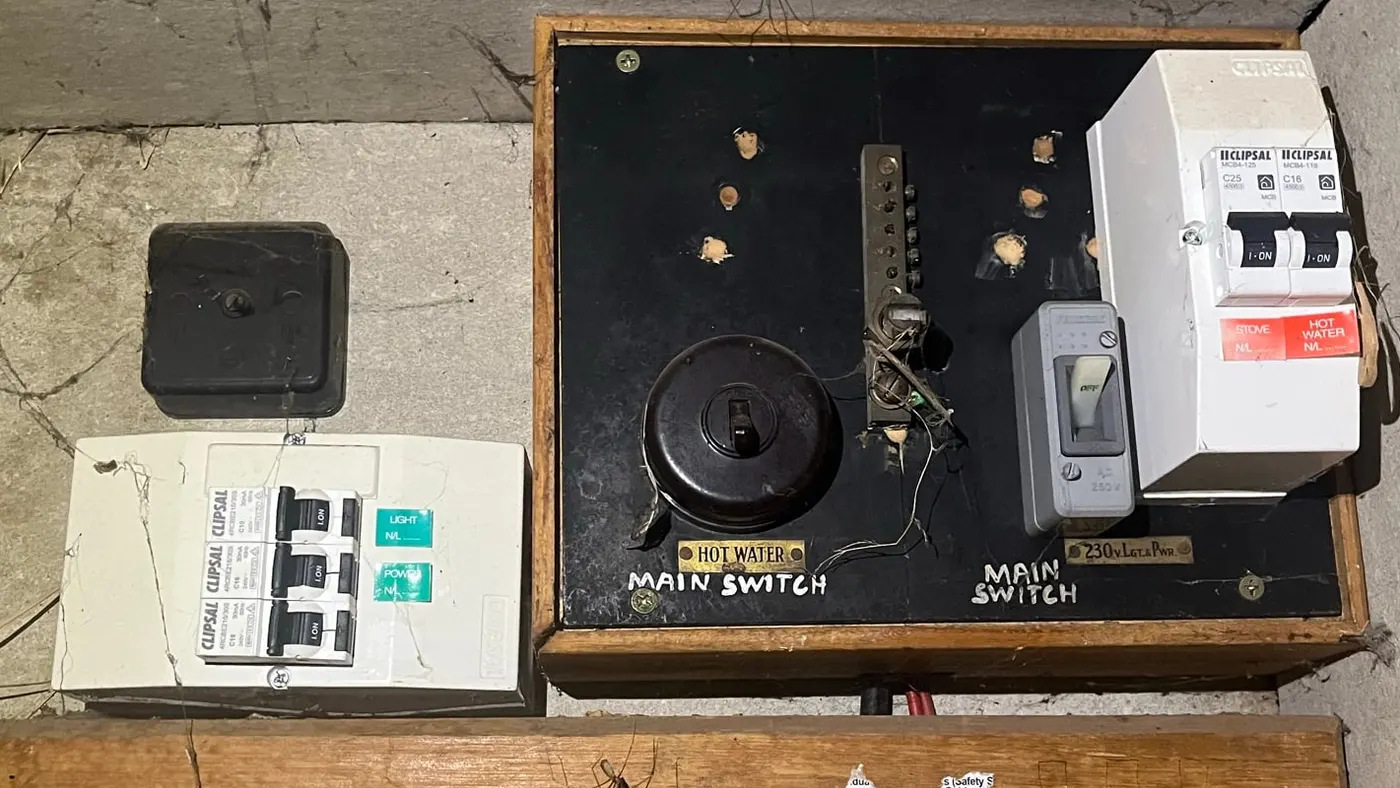
Does a 1970s house need rewiring? Not automatically. A house built in the 1970s is now around 50 years old, and Energy Safe Victoria's advice is to have the wiring checked by a licensed electrician once a house is more than 30 years old, and to check homes built before the 1980s before you move in. Age alone does not decide it. The condition of the wiring does.
The answer can be as small as a switchboard upgrade and a few worn power points, or as big as rewiring part or all of the house. An inspection with proper testing is the only way to know which applies to yours.
- ESV advice
- Have the wiring checked if the house is over 30 years old
- Before you move in
- ESV: check homes built before the 1980s
- Age alone
- Does not mean a rewire. Testing decides
- Who does the work
- A licensed electrician, with a Certificate of Electrical Safety
Why a 1970s house is worth checking
Energy Safe Victoria (ESV) does not single out the 1970s. Its advice covers every older home: have the wiring checked by a licensed electrician if the house is more than 30 years old, and have homes built before the 1980s checked before moving in. A 1970s house meets both tests.
The reasons ESV gives are the ones that matter in a house of this age:
- Insulation degrades. The insulation on household wiring breaks down over time. ESV says degraded wiring can cause fires and that contact with it can be fatal.
- Old wiring and modern demand. ESV says many house electrical fires are caused by old wiring that has degraded or cannot cope with modern demand.
- Fifty years of changes. A house this old has often been altered along the way: an extension, a new kitchen, extra power points, a heater or an air conditioner. The wiring in one house can be a mix of original and later work, done at different times by different people, not always with paperwork to show for it.
None of that means your house needs rewiring. It means the wiring has earned a proper check. ESV's household wiring page sets out its advice in full.
Warning signs of old or failing wiring
ESV lists these as tell-tale signs that home wiring may be faulty:
- Old switchboards, particularly those without a safety switch
- Old power switches or power points, particularly broken ones
- Flickering lights
- Sparks from the switchboard, switches or power points
Other signs worth acting on in an older house:
- Fuses that blow or safety switches that trip often. Powercor's advice is that frequent fuse blowing or safety switch operation means the wiring and appliances should be inspected.
- A tingle or shock from a tap, showerhead or appliance. Do not touch it again. Call Powercor on 13 24 12 straight away, then have a registered electrical contractor investigate.
- Brittle fittings. Queensland's electrical safety regulator warns that ageing Bakelite fittings, such as light fittings and power points, can become brittle and expose live parts.
- Warm, discoloured or scorched power points and switches, or a burning smell near them.
- Too few power points, so the house runs on power boards and adaptors. ESV advises against piggybacking adaptors.
ESV's advice for a loose, cracked or broken power point or switch is not to touch it or try to repair it: cover it and have a licensed electrician replace it. If you see sparks or smoke, or smell burning, call our 24/7 emergency electricians.
Talk to a licensed Geelong electrician (REC 30925).
What about the cable itself?
Owners of older homes often ask what type of cable they have. The build year is not a reliable guide, so we check rather than guess.
The cable regulators warn about is rubber-insulated cable. The NSW Government's electrical safety advice explains that the rubber coating used on wiring in older homes deteriorates and crumbles away over time, leaving the wire exposed and increasing the chance of fire. Its advice is not to touch old wiring if you find it, and to have a qualified electrician inspect it, which it calls the only way to be sure.
Whether a particular 1970s house has any cable like that depends on what was installed and what has been changed since, so we do not assume either way. Later cable can be damaged too: by heat from old fittings, by rodents, by a nail or screw through a wall, or by circuits that have been overloaded for years. Testing shows the condition of all of it.
What an electrician checks in an older house
A wiring check is a visual inspection plus testing. In a house of this age we look at:
- The switchboard: fuses or circuit breakers, which circuits have a safety switch, and signs of heat. Older meter and switchboard panels can contain asbestos. The national asbestos safety agency describes black or dark brown boards, most installed before 1990, and says drilling, cutting or sanding them can release fibres. Leave an old panel alone until an electrician has looked at it.
- Cable in the roof space and under the floor, where it can be reached safely: perished or brittle insulation, heat damage, loose joins and cable run without proper support.
- Power points, switches and light fittings: cracks, scorching, loose fittings and correct polarity.
- Earthing: the main earth and the earth connection at power points.
- Additions: circuits added for extensions, sheds, heaters or air conditioners, and whether they were done properly.
Testing turns a look into an answer. The tests are the ones an electrician must carry out before certifying new work: earthing continuity, insulation resistance, polarity, correct circuit connections, earth fault-loop impedance and safety switch operation. The insulation resistance test in particular shows whether old cable is leaking current to earth. Our electrical safety inspection covers all of this and explains the results in plain terms.
Rewire, partial rewire or switchboard: what the results can mean
The inspection decides the job, not the build year. This is how findings commonly turn into work:
| What the inspection finds | What it can lead to |
|---|---|
| Cable tests sound, but the board has old fuses or few safety switches | A switchboard upgrade with a safety switch on every circuit, possibly with no rewiring at all |
| One or two circuits fail their tests, or an addition was wired badly | Repair or replace those circuits only: a partial rewire |
| Insulation has perished or gone brittle through much of the house | A full rewire, which can be staged room by room |
| Cracked, loose or brittle power points, switches and fittings | Replace the fittings. Worn fittings can sit on sound cable |
| Not enough circuits for new appliances | New circuits, and sometimes a supply upgrade through Powercor |
| Everything tests well | Keep it. Test your safety switches every three months, as ESV recommends |
If a rewire is needed, it is also the cheapest moment to add power points, lights and data points, because new cable is being planned and run anyway. Our house rewiring page explains full, partial and staged rewires.
Not sure what you need? Tell us what is happening and we will talk it through.
Fuses, safety switches and the switchboard in an older home
The switchboard is where an older house most often shows its age, and it is easy to mistake a board problem for a wiring problem, or the other way round.
- Fuses and circuit breakers protect the wiring against overloads and short circuits. ESV is clear that they are not safety switches.
- A safety switch (RCD) protects people. ESV says it cuts the power within 0.03 of a second when it detects a leak that could harm someone. It only protects the circuits it is connected to, so a board with one safety switch may still leave some circuits uncovered.
- A replacement board means safety switches on every circuit. When a switchboard is replaced, the Wiring Rules (AS/NZS 3000) require safety switch protection on all final sub-circuits. Replacing the main switchboard is prescribed work: an independent licensed electrical inspector must inspect it before the power goes back on.
One thing to expect: a new switchboard does not renew the cable behind it. If old wiring is leaking current, a new safety switch can start tripping on a fault the old fuses never reacted to. That is the switch doing its job, and it is why we test the circuits before recommending a board. Our guide do I need to upgrade my switchboard? covers the signs and the current standard.
Older wiring and today's appliances
ESV's point about old wiring that cannot cope with modern demand shows up most when big new loads are added to an older house:
- Induction cooktops and electric ovens. Heavy loads, and every cooking appliance with an open cooking surface needs an isolating switch that is visible, readily accessible and not mounted on the appliance.
- Air conditioning, especially more than one unit.
- An EV charger.
- Studies and entertainment areas that end up running on power boards instead of power points.
Powercor lists EV chargers, larger air conditioning and new appliances among the common reasons to upgrade a property's supply. Changes to supply capacity, phases or the meter panel are requested from Powercor by a registered electrical contractor. Powercor says most of these works take 3 to 8 weeks, and its charges are separate from the electrician's quote. If you are planning any of these, have the wiring and switchboard checked first so one plan covers both. See mains and supply upgrades.
What affects the cost of rewiring a 1970s house
We do not price a rewire from the build year. It is quoted after an inspection, and these are the things that move the price:
- How much needs replacing: a few circuits, one part of the house, or everything.
- The switchboard: whether it is replaced at the same time, and whether an old meter panel needs extra care.
- Access: roof space height, underfloor clearance and whether cable can follow existing paths.
- Size and layout: the number of rooms, storeys and circuits.
- What you add: extra power points, lighting, data points or circuits for new appliances.
- Whether you live there during the work: working a section at a time takes longer than rewiring an empty house.
- Supply changes: any Powercor alteration is charged by Powercor, separately.
Patching and painting where a wall or ceiling has to be opened are not electrical work, so allow for a plasterer or painter if needed.
What happens during a rewire, and what to do next
A rewire is planned and staged. It starts with the inspection and a written quote. New cable is run through the roof space, wall cavities and underfloor, the new circuits are connected to a switchboard with safety switches, and every circuit is tested. If the main switchboard or consumer mains are replaced, the supply may need to be isolated by Powercor, by an appointment the contractor arranges, and the new board stays off until an independent inspector has inspected it. You receive a Certificate of Electrical Safety. Keep it: the electrician only has to keep a copy for three years. None of this is DIY work, which is illegal in Victoria.
If your house was built in the 1970s and the wiring has never been checked, start there. CabledIN's licensed electricians (REC 30925) test first and recommend the smallest job that makes the house safe, backed by our lifetime workmanship warranty. See house rewiring in Geelong or call 1300 025 555.
Frequently asked questions
Does a 1970s house need rewiring if nothing seems wrong?
Not necessarily. Energy Safe Victoria advises having the wiring checked once a house is more than 30 years old, and homes built before the 1980s checked before you move in. Testing shows whether the cable is sound or needs replacing.
How do I know if my house needs rewiring?
Warning signs include an old switchboard without safety switches, broken or scorched power points and switches, flickering lights, sparks, and fuses or safety switches that trip often. An inspection with insulation resistance testing is the only way to be sure.
Is old wiring dangerous?
It can be. Energy Safe Victoria says degraded wiring can cause fires and that contact with it can be fatal. If you find old or damaged wiring, do not touch it, and have a licensed electrician check it.
Should I get the wiring checked before buying an older house?
Yes. Energy Safe Victoria advises checking homes built before the 1980s before you move in. A pre-purchase electrical inspection tells you the condition of the switchboard and wiring before you commit.
Will a new switchboard fix old wiring?
No. A switchboard upgrade adds safety switches and modern circuit breakers, but the cable behind it stays the same. If old cable is leaking current, the new safety switches may trip until that circuit is repaired.
Can I rewire just part of the house?
Yes, if testing shows only some circuits have failed or one part of the house has older wiring. Sound circuits can stay, and the work can be staged over time.
Can I do some of the rewiring myself to save money?
No. DIY electrical work is illegal in Victoria, and Energy Safe Victoria warns it can be deadly. All of it has to be done by a licensed electrician working for a registered electrical contractor.
Do I get a certificate after rewiring?
Yes. All electrical installation work in Victoria needs a Certificate of Electrical Safety. If the main switchboard or consumer mains were replaced, that part is also inspected by an independent licensed electrical inspector.
Still have a question? Ask the CabledIN team.