
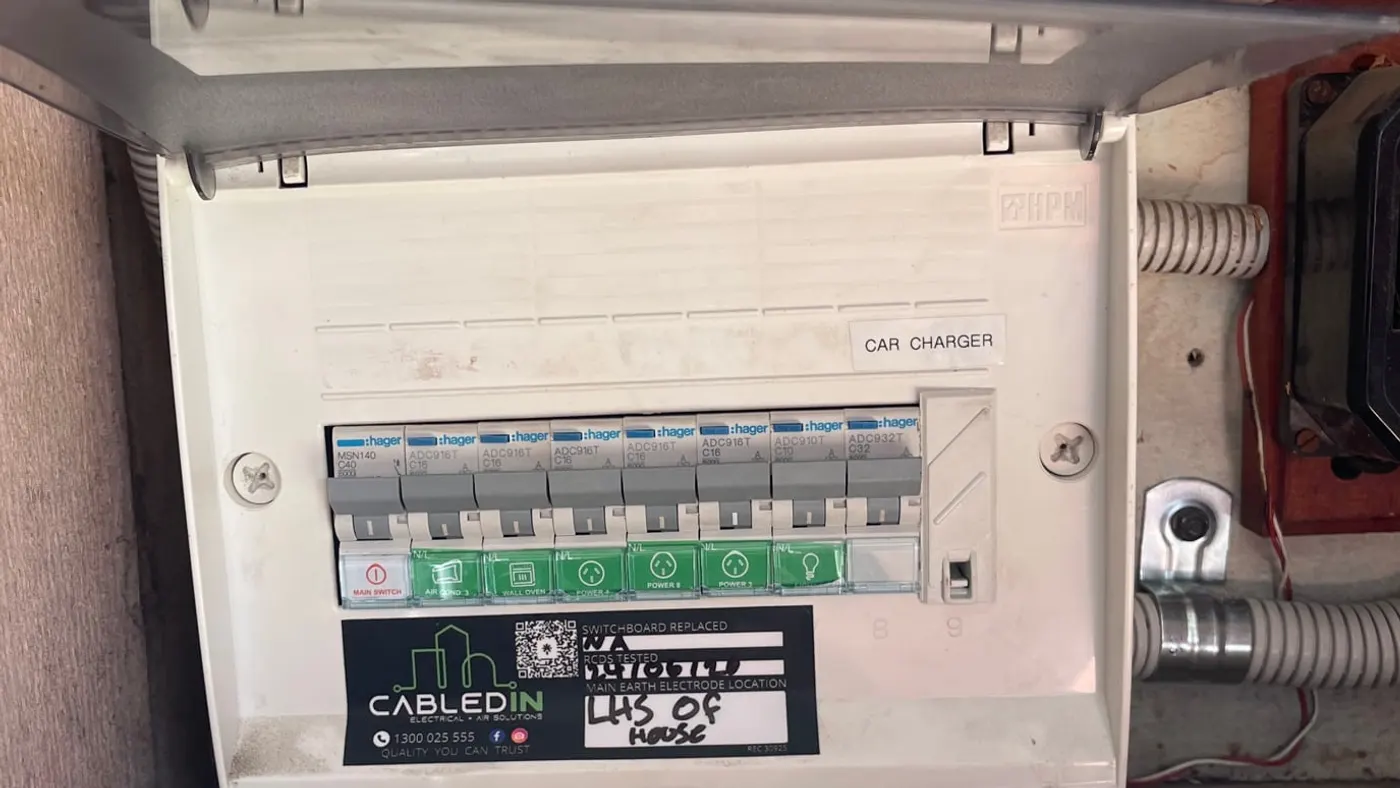
How to find a qualified, licensed electrician in Geelong: ask for their registered electrical contractor (REC) number and the electrician's licence, check both on Energy Safe Victoria's free public registers, and confirm you will get a Certificate of Electrical Safety for the work. In Victoria an electrician must work for a registered electrical contractor to do work for a customer, and the contractor must show its REC number in its advertising.
Then compare written quotes for the same job, sign a written contract, and never pay the full amount up front. "Level 1" and "Level 2" are not among the licence types Energy Safe Victoria lists.
- The electrician
- Holds a licence issued by Energy Safe Victoria, such as an A Grade licence
- The contractor
- A registered electrical contractor, with its REC number in its advertising
- How to check
- Energy Safe Victoria's free public registers, or 1800 815 721
- What you receive
- A Certificate of Electrical Safety for all electrical installation work
Licence and registration: the two things to check
Two separate credentials sit behind every electrical job in Victoria. The person doing the work needs a licence. The outfit taking your job needs to be a registered electrical contractor. Energy Safe Victoria (ESV) issues both.
| Credential | Who holds it | What it allows | How you check it |
|---|---|---|---|
| A Grade licence | The electrician doing the work | Electrical installation work without supervision, as an employee. It does not allow contracting for profit or reward | Ask to see the licence, and search ESV's Licensed Electrical Worker register |
| Registered electrical contractor (REC) | The contractor that quotes and takes your job | Employing electricians to carry out installation work for profit | The REC number in its advertising, and ESV's REC Register |
| Electrical inspector licence | The independent inspector | Inspecting prescribed work, such as a new switchboard or consumer mains | ESV's Licensed Electrical Inspector Register |
The split matters. An electrician with an A Grade licence who takes jobs directly from the public needs REC registration as well, so "A Grade" and "REC" are not the same thing. Every REC must have a technical supervisor who holds an A Grade licence, a business supervisor, and current public liability insurance. Registration runs for up to 5 years.
How to check an electrician's licence and REC number
- Find the REC number. A registered electrical contractor must include its registered number in advertisements and statements about its electrical work. Look on the website and the written quote. If you cannot find one, ask for it.
- Ask to see the licence. ESV's advice is to always ask to see a tradesperson's licence. A licensed electrical worker has an identification card endorsing them to carry out electrical work.
- Search the public registers. ESV's public registers are free: the REC Register, the Licensed Electrical Worker search, the Licensed Electrical Inspector Register and a Certificate of Electrical Safety search. Each one asks you to solve a CAPTCHA before it searches.
- Call if anything does not line up. ESV's licensing line is 1800 815 721. Call before you book, not after the work is done.
One trap to avoid: electricians are licensed by Energy Safe Victoria, not the Building and Plumbing Commission. Consumer Affairs Victoria notes that it is builders and plumbers who register with the Commission, so check an electrician on ESV's registers instead.
Talk to a licensed Geelong electrician (REC 30925).
Level 1 vs Level 2 electrician: what Victoria uses instead
"Level 1" and "Level 2" are some of the most searched electrician terms, but they do not appear among the licence types ESV lists. ESV's licence types are the A Grade licence, the registered electrical contractor's licence, the electrical inspector licence and the switchgear worker's licence. Victoria's law also names other classes, such as connection workers and lineworkers. If you see "Level 2" on a website, it is not a Victorian licence class.
What people usually mean is: who can work on my meter, mains and power supply? In Victoria that work is split like this:
| Part of the supply | Who is responsible |
|---|---|
| Poles, wires and underground services up to your property | Powercor, the distributor for Geelong and the region |
| Changes to the meter or meter panel, supply capacity or phases | An alteration request that only a registered electrical contractor can lodge with Powercor |
| Consumer mains, main earthing or a replaced main switchboard on your side | A licensed electrician working for a REC. This is prescribed work, inspected by an independent licensed electrical inspector |
| Everything else in the house: lights, power points, appliances | A licensed electrician working for a REC |
So for a meter box, mains or supply job in Geelong, the question to ask is whether the REC deals with Powercor directly and arranges the inspection, not what level the electrician is. Our mains upgrades and Powercor defect repairs page covers that work.
Questions to ask before you book
- What is your REC number? A genuine contractor gives it without hesitation, because the law requires it in their advertising.
- Will the electrician doing the work hold a licence, and can I see it?
- Will I get a Certificate of Electrical Safety? The answer should always be yes, for any installation work, whatever the size of the job.
- Is this prescribed work, and will you arrange the inspection? Replacing a main switchboard, the consumer mains or the main earthing system has to be independently inspected.
- Will you deal with Powercor if the job needs it? Supply alterations can only be lodged by a REC.
- Can I have the quote in writing, describing the work?
- What warranty do you give on your workmanship?
Reputation counts too. Read what other local homeowners say, and check that the reviews describe the kind of job you need. You can read our Google reviews the same way.
Quotes, contracts and deposits
Consumer Affairs Victoria's general advice for hiring any tradesperson applies to electricians too. It is consumer guidance, not a law that binds the electrician, but it is sound:
- Check the registration or licensing, reputation and references.
- Get at least three quotes on the same detailed description of the job, so you compare like with like.
- Have a written contract for all work, even small jobs.
- Never pay the full amount up front.
- Keep a deposit to no more than 10 per cent of the total price on smaller jobs, as Consumer Affairs Victoria advises.
- Be wary of people who knock on your door or phone unexpectedly offering cheap deals on jobs around your home.
Consumer Affairs Victoria's checklist for home improvement jobs has the full list.
Not sure what you need? Tell us what is happening and we will talk it through.
Warning signs, and what the law says
ESV names two clear warning signs: a contractor who will not show you a licence, and a contractor who does not issue a Certificate of Electrical Safety. In the second case, ESV says to contact Energy Safe Victoria immediately. Add these to the list:
- No REC number anywhere in the advertising or on the quote.
- Being told a certificate is not needed for a small job. It is needed for all electrical installation work.
- Pressure to pay the full amount before the work starts.
- An offer to let you do part of the wiring yourself to save money. DIY electrical work is illegal in Victoria.
The Electricity Safety Act 1998 backs these up with penalties. Carrying out, offering to carry out, or holding out as willing to carry out licensed electrical work without a licence carries up to 50 penalty units, so offering or advertising the work without a licence is itself an offence. Carrying on electrical contracting without registration, or a contractor employing an unlicensed worker, carries up to 50 penalty units for a person and 250 for a company. Failing to complete and give a certificate carries up to 60 penalty units.
The certificate a licensed electrician must give you
The Certificate of Electrical Safety is a legal document. Only registered contractors and licensed workers can buy or lodge one, which makes it the clearest sign that a licensed electrician did the work. The electrician gives one copy to you and one to ESV. When it is due, under the Electricity Safety Act 1998:
| Type of work | Inspection | Your copy is due |
|---|---|---|
| Prescribed work, such as replacing a main switchboard, the consumer mains or the main earthing system | Independent licensed electrical inspector, arranged by the contractor | 4 business days after the certificate of inspection is given |
| Other work, such as lights, power points or safety switches | None required | One month after the certificate of compliance is completed |
An electrician cannot refuse to issue a certificate for any reason, including payment issues or contract disputes. If an electrician refuses to arrange an inspection or provide a certificate, report it to ESV. If work was done in the last three years and no certificate was issued, a complaint can be lodged. Keep your copy with the house papers: the electrician only has to keep theirs for 3 years.
Finding a licensed electrician in Geelong: the local checks
- Powercor is the local network. Geelong, the Bellarine Peninsula, the Surf Coast and Golden Plains are on the Powercor network, so any supply change is lodged with Powercor by a REC. Ask whether the contractor does this regularly.
- Defect notices. If Powercor has sent you a defect notice, the repair has to be done by a REC, who sends the certificate to Powercor. Our guide what a Powercor defect notice means explains the steps.
- Older homes. ESV advises that a house over 30 years old should have its wiring checked by a licensed electrician. An electrician who offers a written inspection gives you a baseline before any bigger job.
- After hours. Check that the electrician you call out of hours is licensed too, and that any repair comes with a certificate. Our emergency electricians work 24/7.
What to do next
Before you book anyone, run the four checks above: REC number, licence, the public register, and a written quote that says a certificate is included. For an older home, or before buying or selling, a written electrical safety inspection is a good first job, because it shows you how the electrician works before you commit to anything bigger, such as a switchboard upgrade.
CabledIN is a registered electrical contractor, REC 30925, based in North Geelong, with more than 20 years' experience, a lifetime workmanship warranty and 2,000+ five-star Google reviews. Every installation job comes with a Certificate of Electrical Safety, and we arrange the inspection and the Powercor application where a job needs them. We work across Geelong, the Bellarine Peninsula, the Surf Coast and Golden Plains. Book an electrical safety inspection or call 1300 025 555.
Frequently asked questions
How do I check if an electrician is licensed in Victoria?
Ask to see their licence, which comes with an identification card, and search Energy Safe Victoria's free Licensed Electrical Worker register and REC Register. You can also call ESV's licensing line on 1800 815 721.
What is the difference between a Level 1 and a Level 2 electrician?
Neither term appears among the licence types Energy Safe Victoria lists. In Victoria the electrician holds a licence such as an A Grade licence, the contractor holds REC registration, and supply changes are lodged with Powercor by a REC.
What is a REC number?
It is the registration number of a registered electrical contractor, the contractor that takes on electrical work for customers. The contractor must show it in its advertising, and you can look it up on ESV's REC Register.
Can an A Grade electrician do work for me directly?
An A Grade licence allows installation work without supervision, as an employee, but not contracting for profit or reward. An A Grade electrician who takes jobs directly from the public also needs REC registration.
Do I need a certificate for a small electrical job?
Yes. A Certificate of Electrical Safety must be provided for all electrical installation work, whatever the size of the job, and the electrician gives a copy to you and to ESV.
What if my electrician will not give me a certificate?
An electrician cannot refuse to issue one for any reason, including payment issues or contract disputes. Report it to Energy Safe Victoria. A complaint can be lodged for work done in the last three years with no certificate.
Should I check an electrician with the Building and Plumbing Commission?
No. Electricians are licensed by Energy Safe Victoria. The Building and Plumbing Commission registers builders and plumbers, so use ESV's registers for an electrician.
How many quotes should I get for electrical work?
Consumer Affairs Victoria suggests at least three quotes on the same detailed description of the job, a written contract even for small jobs, and never paying the full amount up front.
Still have a question? Ask the CabledIN team.