
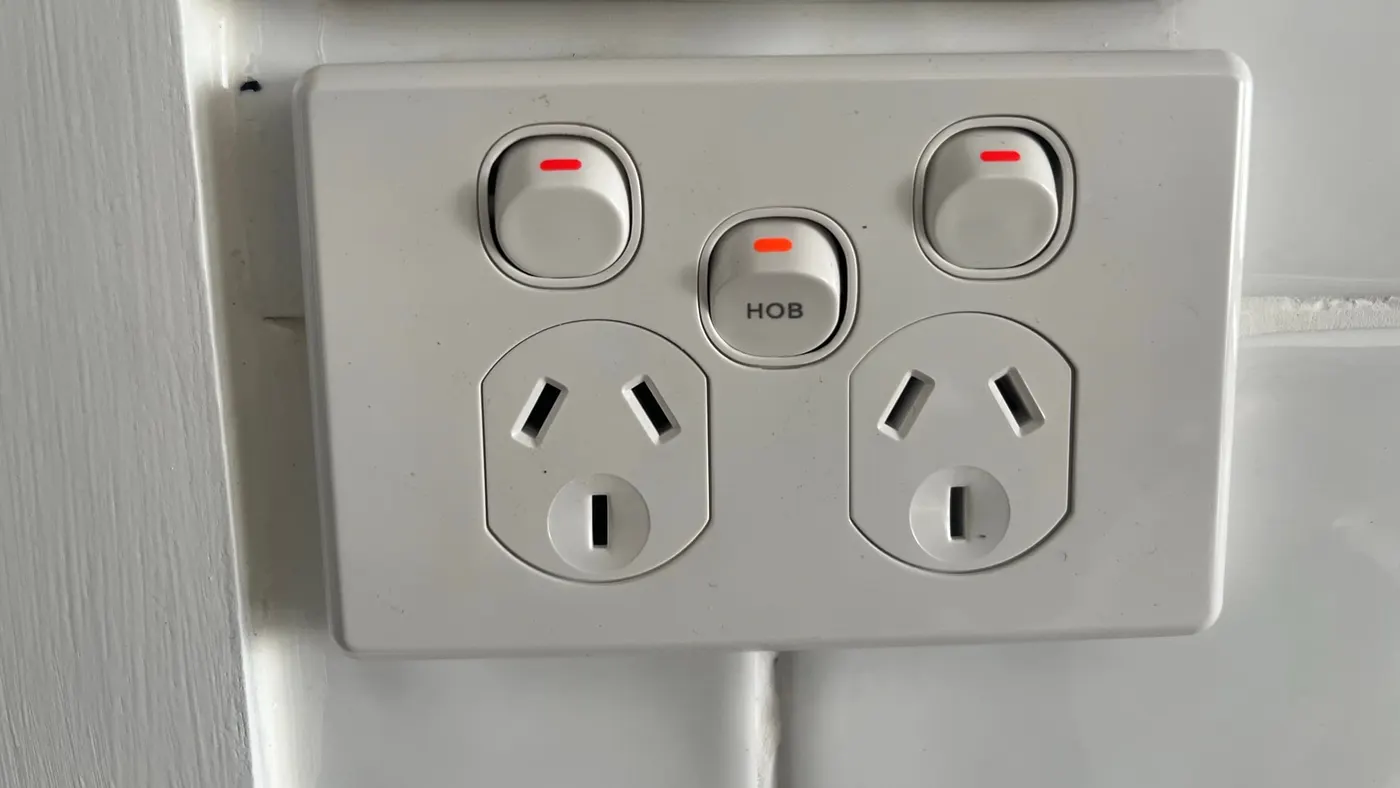
An induction cooktop needs a dedicated circuit from the switchboard, with cable and a circuit breaker sized to the cooktop's rating and an isolating switch, fitted by a licensed electrician.
The Australian Government's Your Home guide says induction cooktops need to be hardwired by an electrician and will need a new dedicated circuit back to the switchboard, especially when they replace a gas cooktop that plugged into a power point. If the switchboard has no room for that circuit, it may need upgrading. A typical single-phase connection is enough for most all-electric homes, so three-phase power is unlikely to be needed for the cooktop.
- Circuit
- A new dedicated circuit back to the switchboard (Your Home)
- Cable and circuit breaker
- Sized to the cooktop's rating, as its installation instructions set out
- Isolating switch
- Visible, readily accessible, within 2 m and not on the appliance (ESV)
- Gas cooktop removal
- A licensed gasfitter disconnects the gas; the electrician does the wiring
Do induction cooktops need special wiring?
Usually, yes. Your Home says induction cooktops may need special electrical connections because of the amount of power they draw: they are hardwired by an electrician, not plugged into a power point, and need a new dedicated circuit back to the switchboard.
A dedicated circuit is a circuit that runs from the switchboard to one appliance and supplies nothing else. One manufacturer's installation guide we read puts it plainly: "A separate circuit, servicing only this appliance is required." The circuit ends at an isolating switch near the cooktop, and the cooktop is connected from there.
Induction works differently from gas or a ceramic cooktop. Your Home explains that it heats the pan directly through an electromagnetic field, so the glass stays mostly cool except where the hot pan sits. Your Home also says to check the cooktop's power in kilowatts (kW) before you buy, to make sure your home has the electrical capacity. If you are replacing an older electric cooktop, the existing circuit has to suit the new cooktop's rating, which is something an electrician checks before it goes in.
What size circuit and cable does an induction cooktop need?
The size is set by the cooktop, not by one rule for every model. The manufacturer's installation instructions give the cable and circuit breaker each model needs, and the cable must meet AS/NZS 3000, the Australian and New Zealand wiring rules. That is why this guide gives no single amp or kW figure: ratings differ from model to model.
| Part | What it does | What sets it |
|---|---|---|
| Dedicated circuit | Carries power from the switchboard to the cooktop alone | The cooktop's rating and the installation instructions |
| Circuit breaker | Protects the circuit's cable from overloads and short circuits | The rating in the installation instructions |
| Cable | Runs from the switchboard to the kitchen | The cooktop's rating and AS/NZS 3000 |
| Safety switch (RCD) | Cuts the power if current leaks to earth, for example through a person | We fit one on every new circuit we add |
| Isolating switch | Turns off all power to the cooktop | ESV's location rules and the installation instructions |
An RCD (residual current device), also called a safety switch, is different from a circuit breaker: the breaker protects the wiring, while the safety switch protects people. Every new circuit we add is protected by a safety switch. Our safety switch (RCD) installation page explains more.
Talk to a licensed Geelong electrician (REC 30925).
Will my switchboard need an upgrade?
Sometimes. Your Home says that if the switchboard does not have space for a new circuit, it may need to be upgraded. The NSW Government's energy site adds that a dedicated high-power circuit could involve a switchboard upgrade, and that your electrician will assess this.
Before an induction cooktop goes in, we check the switchboard for three things:
- whether there is room for a new circuit breaker and safety switch;
- whether the board's age and condition suit new work, since ESV lists old switchboards, particularly those without a safety switch, among the signs that home wiring may be faulty;
- whether the home's supply can carry the cooktop alongside everything else you run.
If the board needs work, we tell you before anything starts. Our guide to whether you need to upgrade your switchboard covers the signs, and switchboard upgrades covers the work itself.
Where does the isolating switch go?
Near the cooktop, where you can see and reach it, but not on the cooktop itself. An isolating switch is a switch that cuts all power to one appliance. ESV says every cooking appliance with an open cooking surface, including an induction cooktop, needs one that is:
- visible and readily accessible;
- within 2 metres of the appliance;
- not mounted on the appliance.
ESV also says no switch or power point should sit within 150 mm of the edge of the cooking surface. One manufacturer's manual we read adds that the isolation device must disconnect the cooktop from the mains at all poles. We agree the switch's position with you before it is fitted.
Do I need three-phase power for an induction cooktop?
Probably not. Your Home says a typical single-phase connection is adequate for most all-electric households, and that it is unlikely you will need three-phase electricity for the cooktop.
Three-phase power is a supply that uses five wires instead of three and provides more electricity to run more or larger appliances (energy.gov.au). Most Australian homes are single-phase. Some cooktop models can be connected to either a single-phase or a three-phase supply, and one manual we read covers single-phase or two-phase connection, so the installation manual for your model says which applies.
If your home already has three-phase power, we connect the cooktop the way its manual allows. If you are weighing up three-phase for other reasons, such as faster car charging, see do I need three-phase power at home?
Not sure what you need? Tell us what is happening and we will talk it through.
What happens to the gas when you switch to induction?
A licensed gasfitter disconnects the gas; an electrician does the wiring. ESV says to always use a licensed gasfitter for any gas work, including disconnecting gas appliances, and never to do gas work yourself.
- The gas side: Your Home says a licensed gasfitter caps the gas service when a gas cooktop or stove is taken out. If you also plan to close the gas service to your home, Your Home says to do that before removing the cooktop.
- The electrical side: we do the electrical side of changing a cooktop, including the new circuit, any switchboard work, the isolating switch and the connection. We do not do gas work.
- The benchtop: the new cooktop may need a different cut-out. Your Home notes that engineered stone may no longer be cut, so the cut-out cannot be made bigger in those benchtops. Check the cut-out size in the installation manual before you buy.
- The paperwork: a Certificate of Electrical Safety must be provided for all electrical installation work in Victoria, whatever its size.
What else should I check before buying?
Check the rating, the cut-out and your pans before you choose a model. These checks come from Your Home and the installation manuals we have read:
| Check | Why it matters |
|---|---|
| Power rating (kW) | Sets the circuit, cable and circuit breaker, and whether the switchboard has capacity |
| Supply type in the manual | Some models suit single-phase only, some can be connected more than one way |
| Power sharing | Some lower-power models avoid an upgrade to the electrical connection: when one zone is turned up, another turns down |
| Cut-out size and clearances | The benchtop opening must fit, and specific clearances help the cooktop shed heat safely |
| Cookware | Pans need a ferrous base: if a magnet sticks to the bottom, the pan should work |
| Pacemaker or medical implant | Your Home says to check with your doctor first, as there is a small risk with some devices |
Your Home notes that most cooking is done on low settings, so a power-sharing model may suit the way you cook.
What to do next
Pick your cooktop, note its kW rating and keep the installation manual, then book an electrician to check the circuit and switchboard before installation day. CabledIN Electrical Solutions (REC 30925), based in North Geelong, offers oven and cooktop installation and electrical appliance installation for homes across greater Geelong, the Bellarine Peninsula, the Surf Coast, Golden Plains and Werribee. Call 1300 025 555; we are open 24 hours, 7 days.
Our job records show more than 300 appliance jobs, more than 55 of them with cooktops, induction cooktops included. Rebecca, a customer, wrote about a "great installation of electric cooktop & great communication throughout as well". See oven and cooktop installation, electrical appliance installation and our Geelong electrician page for the suburbs we cover.
We price the job once we have seen it, so you know the price before any work starts. Book an electrician on 1300 025 555.
Frequently asked questions
Does an induction cooktop need a dedicated circuit?
Usually, yes. The Australian Government's Your Home guide says induction cooktops need to be hardwired by an electrician and will need a new dedicated circuit back to the switchboard, especially when they replace a gas cooktop that plugged into a power point. A dedicated circuit supplies the cooktop and nothing else, with cable and a circuit breaker sized to the cooktop's rating.
Can I plug an induction cooktop into a normal power point?
A built-in induction cooktop is not plugged into a normal power point. Your Home says induction cooktops need to be hardwired by an electrician, and the manufacturer's installation instructions set the cable and circuit breaker each model needs. The cooktop is connected through an isolating switch that ESV says must be visible, readily accessible and within 2 metres of the appliance.
Will I need a switchboard upgrade for an induction cooktop?
Sometimes. Your Home says that if your switchboard does not have space for a new circuit, it may need to be upgraded, and the NSW Government's energy site says your electrician will assess this. An older board without a safety switch, or one with no spare room, is the usual reason. CabledIN checks the switchboard and tells you before any work starts.
Do I need three-phase power for an induction cooktop?
Probably not. Your Home says a typical single-phase connection is adequate for most all-electric households and that it is unlikely you will need three-phase electricity for the cooktop. Some models can be connected to either single-phase or three-phase supply, so the installation manual for your model says which connection applies.
Who disconnects the gas when I change to an induction cooktop?
A licensed gasfitter. Energy Safe Victoria says to always use a licensed gasfitter for gas work, including disconnecting gas appliances, and Your Home says the gasfitter caps the gas service when a gas cooktop is taken out. The electrician does the electrical side: the new circuit, any switchboard work, the isolating switch and the connection. CabledIN does the electrical side only.
Can I install an induction cooktop myself?
No. In Victoria, electrical work must be done by a licensed electrician, and Energy Safe Victoria says doing it yourself is illegal and can be deadly. Manufacturers' manuals also say all electrical connections must be made by a qualified electrician. A Certificate of Electrical Safety must be provided for all electrical installation work, including a new cooktop circuit.
How close to the cooktop can the isolating switch be?
Energy Safe Victoria says the isolating switch for a cooktop must be visible, readily accessible and within 2 metres of the appliance, and must not be mounted on the appliance. It also says no switch or power point should be within 150 mm of the edge of the cooking surface. The installation manual for your model may add its own requirements.
Will my pots and pans work on an induction cooktop?
Pans for induction need a ferrous base, meaning cast iron, mild steel and most, but not all, stainless steel. The Australian Government's Your Home guide suggests a simple test: if a magnet sticks to the bottom of the pan, it should work on an induction cooktop. A pan without a ferrous base will not work on induction.
Still have a question? Ask the CabledIN team.