
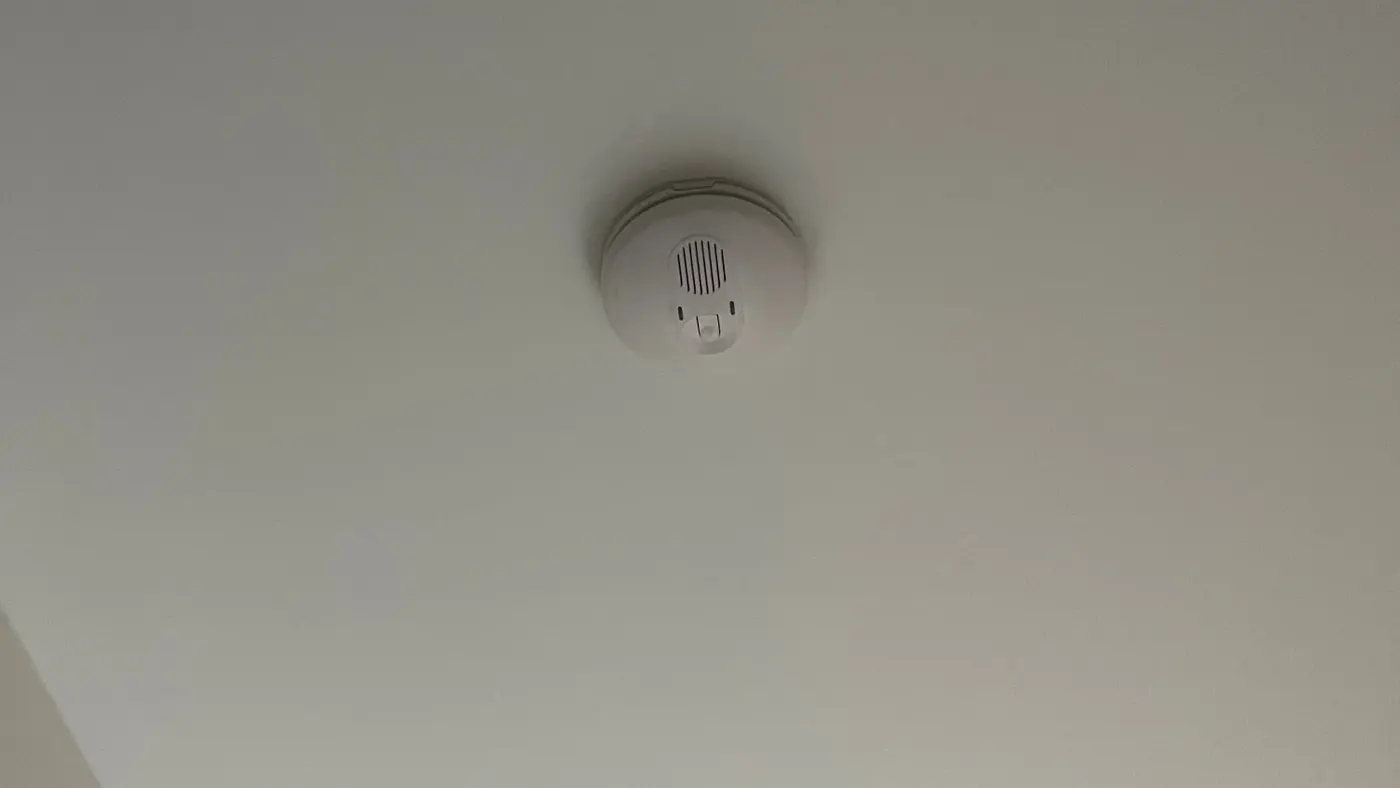
If you are asking "why is my smoke alarm beeping or chirping?", a short chirp that repeats every minute or so usually means a flat battery, a fault or an alarm at the end of its life.
A loud, continuous alarm is different: the alarm has sensed smoke, or something it reads as smoke, such as steam or cooking fumes, so check for a fire first. The Victorian Government says a chirp means the battery is almost flat, and that every smoke alarm, battery-only or hard-wired, has a 10-year life. A hard-wired (240 volt) alarm must be replaced by a licensed electrician.
- A chirp every 40 seconds to a minute
- Usually a low battery, a fault or an alarm at the end of its life
- A loud, continuous alarm
- Smoke, steam or cooking fumes: check for fire first
- Replace smoke alarms
- Every 10 years, all types (Victorian Government, FRV, CFA)
- Hard-wired 240 volt alarms
- Installed and replaced by a licensed electrician only
What is the difference between a chirp and a beep?
A chirp is a single short sound that repeats at a steady interval, and it is the alarm asking for attention. A full alarm is loud and continuous, and it means the alarm has sensed smoke or something it reads as smoke.
| What you hear | What it usually means | What to do |
|---|---|---|
| One chirp every 40 seconds to a minute (the range in the manuals we have read) | A low or flat battery | Replaceable battery: change it. Sealed 10-year battery: replace the whole alarm |
| A chirp from an alarm close to 10 years old | The end of its life | Check the date on the back label and replace the alarm |
| A chirp that keeps going after a new battery | A fault, or an alarm past its life | Replace the alarm. Hard-wired: a licensed electrician |
| Three beeps when you hold the test button | Normal: the alarm is working | Nothing. Fire Rescue Victoria (FRV) says to test this way every month |
| A loud alarm with no fire | Steam, cooking fumes or dust | Check for fire first, clear the air, and clean the alarm once it is quiet |
| Every alarm in the house sounds at once | Interconnected alarms: one has sensed something | Check every room for smoke or fire first |
Why does my smoke alarm chirp every minute?
A steady chirp usually means a low battery, a fault, or an alarm at the end of its 10-year life. The Victorian Government says a chirping alarm has a battery that is almost flat and needs replacing straight away.
The interval depends on the model. One manufacturer's manual we read describes a chirp about every 40 seconds, with a red light flashing, when the battery is low. Another describes a chirp once every minute when the battery is flat. Both alarms have sealed batteries, so both manuals say to replace the whole alarm.
What to do depends on the kind of alarm you have:
- Replaceable 9 volt battery: change the battery. FRV says to change these batteries every year anyway.
- Sealed 10-year lithium battery: the battery cannot be changed. CFA (the Country Fire Authority) says the whole unit is replaced after 10 years, and the manuals we have read say a low-battery chirp means the whole alarm is replaced.
- Hard-wired 240 volt alarm: it runs on mains power with a backup battery, which may be replaceable or sealed. CFA says hard-wired alarms must be replaced by a licensed electrician.
Some alarms let you silence a low-battery chirp for several hours with the test button (10 hours in one manual we read). That buys time; it does not fix the alarm.
Talk to a licensed Geelong electrician (REC 30925).
Why is my smoke alarm still beeping after I changed the battery?
If it still chirps with a fresh battery, the alarm itself is usually the problem. FRV says a single, occasional beep means you need to change the battery, or the smoke alarm may be faulty and need replacing.
- It is near or past its 10-year life. Check the date on the label on the back. The manuals we have read count the 10 years from the date of manufacture, or in one case from the date it was put into service.
- It has a sealed battery. There is no battery to change, so a low-battery chirp means a new alarm.
- It is hard-wired. The chirp can come from the backup battery or from the alarm itself, and replacing a hard-wired alarm is a licensed electrician's job.
Allison, a customer, rang us for her mother about "relentless beeping smoke alarms". It was not a battery job: the cause was "Out of date alarms and 3 different types". That mix matters, because CFA says all the smoke alarms in a home must use the same technology to connect to one another and work properly.
Why does a hard-wired smoke alarm beep?
A hard-wired alarm chirps for the same reasons as any other: a low backup battery, a fault, or the end of its life. It is connected to your home's 240 volt mains power and, CFA says, must also have a backup battery, so it keeps working in a power outage.
Homes built after 1 August 1997 must have hard-wired alarms with a backup battery, and homes built or substantially renovated after 1 May 2014 that need more than one alarm must have them interconnected. Our guide to smoke alarm rules in Victoria sets out what applies to your home.
Anyone can change a battery, but CFA says 240 volt hard-wired alarms must be installed and replaced by a licensed electrician. If a hard-wired alarm keeps chirping, or it is close to 10 years old, book an electrician. Many of the hard-wired alarms we fit have a sealed 10-year lithium backup battery, so there is no battery to change during their life.
Why do all my smoke alarms go off at once?
Because they are interconnected. CFA explains that when one interconnected alarm goes off, all the smoke alarms in the house go off too, so a fire at one end of the home is heard at the other.
Hard-wired interconnected alarms have backup batteries, so CFA says they still work, and stay connected to each other, in a power outage. All the alarms in the home must use the same connection technology; mixed types may not connect or work properly.
When the whole set sounds, check every room for smoke or fire first. If there is none, one alarm may be reacting to steam, cooking fumes or dust, and the others are following it. Zac, a customer, called us about "our smoke alarms that were going off for hours"; a set that keeps sounding with no smoke is a job for a licensed electrician when the alarms are hard-wired.
Not sure what you need? Tell us what is happening and we will talk it through.
Why does my smoke alarm go off when I cook or shower?
Steam and cooking fumes can set off a smoke alarm, especially an ionisation type. Ionisation and photoelectric are the two main ways smoke alarms sense smoke, and CFA says false alarms from cooking and steam are more likely with ionisation alarms and less likely with photoelectric ones.
- Placement: CFA says smoke alarms are not needed in kitchens, laundries or bathrooms, where they are likely to cause false alarms, and should not go near windows, doors or air ducts, where drafts can affect them.
- Cleaning: the Victorian Government recommends dusting alarms once a year to avoid false alarms, and FRV says to dust, vacuum or gently wipe around the cover. One manual we read also warns that dust from building work can cause false alarms.
- The hush button: some alarms can be paused for a short time with the test button. One manufacturer's manual says to check for a fire before silencing the alarm.
- Do not remove it: since 1 August 1997, every Victorian home must have smoke alarms installed.
If false alarms keep happening, moving the alarm or replacing it with a photoelectric type can help. Moving or replacing a hard-wired alarm is electrician's work.
When do smoke alarms need replacing?
Every 10 years, whatever the type. The Victorian Government, FRV and CFA all say smoke alarms should be replaced every 10 years, whether they are hard-wired or battery-only.
| Type of alarm | Battery | When to replace the alarm | Who replaces it |
|---|---|---|---|
| Battery-only, 9 volt | Replaceable: change it every year (FRV) | Every 10 years | The home owner |
| Battery-only, sealed 10-year lithium | Sealed: cannot be changed | After 10 years, or when it chirps for a low battery | The home owner |
| Hard-wired 240 volt | Backup battery, replaceable or sealed | Every 10 years, or when it is faulty | A licensed electrician only (CFA) |
FRV says it is best to replace old alarms with hard-wired, interconnected alarms, and otherwise with an alarm that has a tamper-proof chamber and a 10-year long-life battery. CFA notes that most smoke alarm warranties expire after 10 years, and that the maker is not responsible for an alarm that fails 10 years after it was made.
What to do next
If a battery-only alarm chirps, change the battery or the alarm. If a hard-wired alarm chirps, keeps sounding for no reason, or is close to 10 years old, book a licensed electrician. CabledIN Electrical Solutions (REC 30925), based in North Geelong, offers smoke alarm installation and replacement for homes across greater Geelong, the Bellarine Peninsula, the Surf Coast, Golden Plains and Werribee, and we are open 24 hours, 7 days on 1300 025 555.
Our job records show more than 350 smoke alarm jobs, most often in Lara, Armstrong Creek, Bell Park, Corio and Leopold. More than 125 of them involved hard-wired or interconnected alarms, and more than 55 used alarms with a sealed 10-year lithium battery. We test smoke alarms in owner-occupied homes as well as rentals. See smoke alarm installation for what the work involves, our Bellarine Peninsula electrician page for Leopold and Ocean Grove, and electrical safety checks if you want the rest of the house looked at too.
We price the job once we have seen it, so you know the price before any work starts. Book an electrician on 1300 025 555. If an alarm is sounding because of a fire, get out and call 000.
Frequently asked questions
Why does my smoke alarm chirp every 30 seconds or so?
A regular chirp from a smoke alarm usually means a low or flat battery, a fault, or an alarm at the end of its 10-year life. The exact interval depends on the model; the manufacturers' manuals we have read give about every 40 seconds and once a minute. Change a replaceable battery. A sealed-battery or hard-wired alarm that keeps chirping needs replacing, and a hard-wired one needs a licensed electrician.
Why is my smoke alarm still beeping after I changed the battery?
A smoke alarm that still chirps with a fresh battery is usually faulty or past its life. Fire Rescue Victoria says a single, occasional beep means change the battery, or the alarm may be faulty and need replacing. Check the date on the back label: every alarm should be replaced after 10 years. Hard-wired alarms must be replaced by a licensed electrician.
Can I replace a hard-wired smoke alarm myself?
No. CFA says 240 volt hard-wired smoke alarms must be installed and replaced by a licensed electrician, and Energy Safe Victoria says doing electrical work yourself is illegal and can be deadly. You can change a replaceable battery yourself. For a hard-wired alarm that chirps, sounds for no reason or is close to 10 years old, book a licensed electrician.
How long do smoke alarms last?
Smoke alarms last about 10 years. The Victorian Government, Fire Rescue Victoria and CFA all say every smoke alarm, hard-wired or battery-only, should be replaced every 10 years, and most warranties end at 10 years. The date is on the label on the back. A sealed 10-year lithium alarm is replaced as a whole unit; its battery cannot be changed.
Why does my smoke alarm beep three times when I test it?
Three beeps when you press and hold the test button means the smoke alarm is working. Fire Rescue Victoria's monthly test is to press and hold the button until the alarm beeps three times. CFA says if it beeps, it is working, and if it does not beep, you need to replace the battery or get a new smoke alarm.
Why does my smoke alarm go off for no reason?
A smoke alarm that sounds with no fire is usually reacting to steam, cooking fumes or dust. CFA says ionisation alarms are more likely than photoelectric ones to false alarm from cooking and steam, and that alarms are not needed in kitchens, laundries or bathrooms. Check for a fire first, clean the alarm, and have an electrician move or replace a hard-wired alarm that keeps doing it.
Do interconnected smoke alarms all need to be the same type?
Yes. CFA says all the smoke alarms in a home must use the same technology to connect to one another and work properly. If one alarm in an interconnected set is a different type, it may not connect, and the set may not all sound together. When we replace hard-wired interconnected alarms, we check that every alarm in the set sounds when one is tested.
Still have a question? Ask the CabledIN team.