
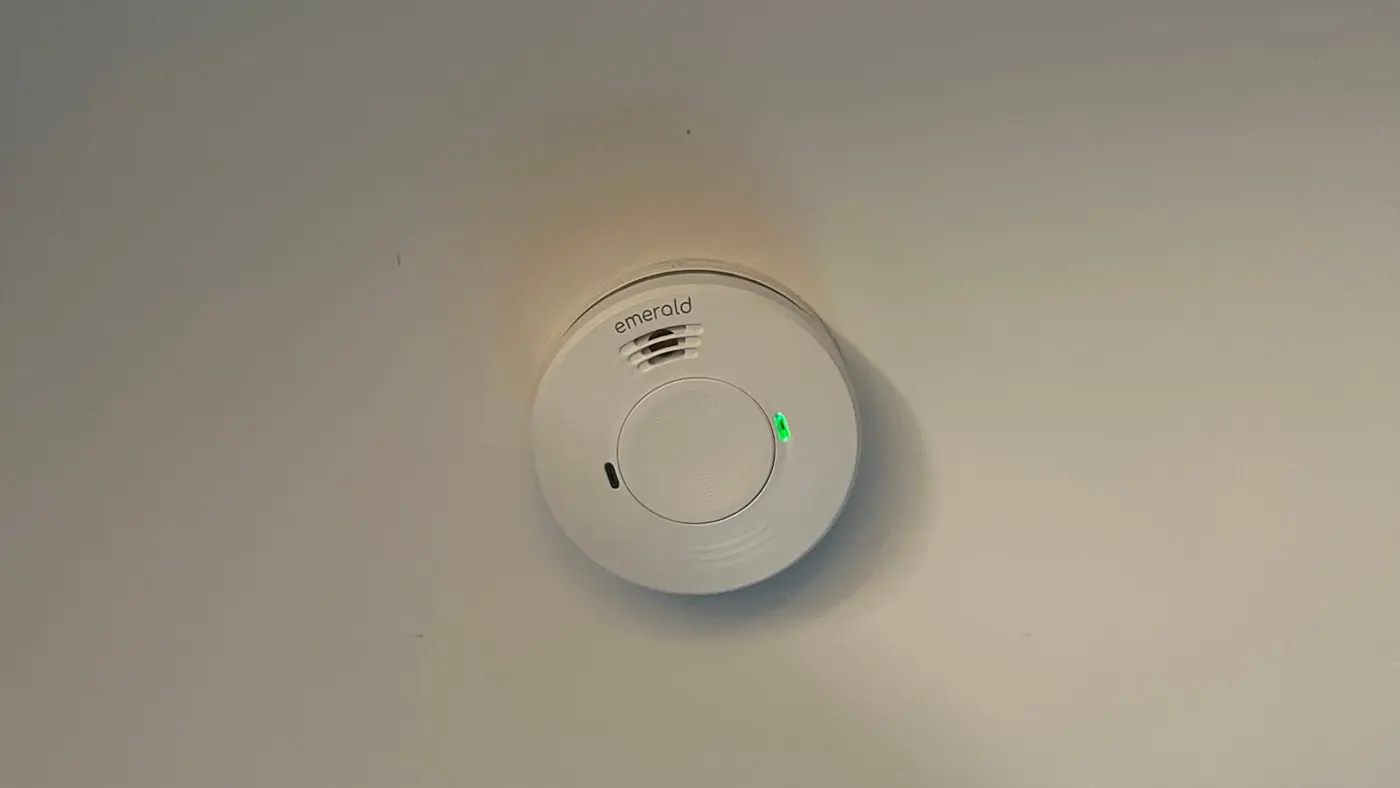
Under the smoke alarm rules in Victoria, every home must have smoke alarms that comply with AS 3786, with at least one on every storey and one between each sleeping area and the rest of the house. Homes built after 1 August 1997 must have 240 V hardwired alarms with a backup battery. Homes built or largely renovated after 1 May 2014 that need more than one alarm must have them interconnected, so they all sound together.
Homes built before 1 August 1997 need only battery alarms by law. Hardwired alarms must be installed and replaced by a licensed electrician, and every alarm should be replaced every 10 years.
- Every home
- AS 3786 alarms on every storey and outside sleeping areas
- Built after 1 August 1997
- 240 V hardwired alarms with a backup battery
- Built or largely renovated after 1 May 2014
- Interconnected, where more than one alarm is needed
- Replace
- Every 10 years, hardwired or battery
Which smoke alarm rules apply to your home
The rules turn on one question: when was your home built, or last largely renovated? Find your home in the table.
| Your home | The legal minimum | What fire services recommend |
|---|---|---|
| Built before 1 August 1997 | Battery-powered smoke alarms that comply with AS 3786 | Fire Rescue Victoria says it is best to replace them with hardwired, interconnected alarms |
| Built after 1 August 1997 | 240 V hardwired alarms with a backup battery | Interconnected alarms, with more alarms in bedrooms and living areas |
| Built or largely renovated after 1 May 2014, needing more than one alarm | 240 V hardwired alarms with a backup battery, all interconnected | Alarms in every bedroom, hallway and living area |
| Every home, whatever its age | At least one alarm on every storey, and one between each sleeping area and the rest of the house | Every alarm replaced every 10 years |
The two official pages word the dates slightly differently. The Victorian Government's smoke alarm page ties the hardwired rule to homes constructed after 1 August 1997, and the interconnection rule to homes constructed or largely renovated after 1 May 2014. Fire Rescue Victoria's page also includes homes largely renovated or extended after each date. If you have renovated or extended, ask your electrician which rule your work falls under before the alarms go in.
Hardwired smoke alarms: what the rule means
A hardwired smoke alarm is connected to your home's 240 V mains power and has a backup battery that keeps it working if the power goes out. Homes built after 1 August 1997 must have them.
Hardwired alarms must be installed, and replaced, by a licensed electrician. A 240 V alarm is wired into a circuit, which makes fitting one electrical installation work, unlike an appliance that simply plugs into a socket. Doing your own electrical work is illegal in Victoria: our guide is DIY electrical work legal in Victoria? explains where the line sits.
Because it is electrical installation work, a new or replacement hardwired alarm comes with a Certificate of Electrical Safety. A certificate must be provided for all electrical installation work, whatever the size of the job.
If your home was built before August 1997, battery alarms are the legal minimum. Moving to hardwired alarms is your choice rather than a requirement, and a sensible time to make it is when the old alarms reach 10 years.
Talk to a licensed Geelong electrician (REC 30925).
Interconnected smoke alarms: what they are and when they are required
Interconnected alarms are linked, so when one sounds, they all sound. A fire that starts in the living area at night then sets off the alarm outside the bedrooms at the other end of the house too, not only the alarm closest to the fire.
In homes built or largely renovated after 1 May 2014, where more than one smoke alarm is needed, all the alarms must be interconnected. Older homes are not required to interconnect, but Fire Rescue Victoria says it is best to replace old alarms with hardwired, interconnected ones.
Wired or wireless interconnection
Alarms can be linked by cable run between them through the roof space, or wirelessly. Fire Rescue Victoria describes wireless interconnection too: when one alarm sounds, all alarms sound. Before you buy a set, ask your electrician which type suits your home and the rule your home falls under.
How to tell if your alarms are interconnected
Warn everyone in the house first, then press the test button on one alarm. If every alarm in the house sounds, they are interconnected. If only that one sounds, they are not linked, or the link is not working.
Where smoke alarms must go, and where fire services recommend them
The legal minimum is the same for every Victorian home:
- At least one smoke alarm on each level of the house.
- One between each sleeping area and the rest of the house. The Country Fire Authority says this is normally the hallway outside the bedrooms.
For full protection, the Victorian Government and fire services recommend alarms in every bedroom, hallway and living area. Smoke alarms are not needed in kitchens, bathrooms or laundries. The requirement covers all homes in Victoria, and the Country Fire Authority notes that includes caravans.
For new homes, the National Construction Code's housing provisions, as applied in Victoria, set the positions as well: alarms on any storey with bedrooms, in every corridor or hallway serving a bedroom, and on each other storey, powered from the mains and interconnected where there is more than one.
How many smoke alarms do I need?
| Home layout | Legal minimum | For full protection |
|---|---|---|
| Single storey, all bedrooms off one hallway | One alarm in that hallway | Add one in each bedroom and living area |
| Single storey, bedrooms in two separate wings | One alarm outside each group of bedrooms | Add one in each bedroom and living area |
| Two storeys, all bedrooms upstairs | One in the upstairs hallway outside the bedrooms, and one downstairs | Add one in each bedroom and living area |
| Two storeys, bedrooms on both levels | One outside each sleeping area, on each level | Add one in each bedroom and living area |
The exact spot in each room depends on the room. Your electrician sets it when the alarms go in.
Which type of smoke alarm to choose
Every alarm must meet the Australian Standard AS 3786. Within that, these are the choices that matter:
- Photoelectric alarms. Fire services recommend photoelectric smoke alarms. It is a recommendation, not a legal requirement.
- 240 V hardwired with a replaceable backup battery. If the backup is a 9 V battery, replace it every year, as the Country Fire Authority advises for all 9 V smoke alarm batteries.
- 240 V hardwired with a sealed 10-year lithium backup battery. No yearly battery change. The whole alarm is replaced when it reaches 10 years. Many of the hardwired alarms we fit are this type.
- Stand-alone battery alarms. The legal minimum in homes built before 1 August 1997.
Whichever you choose, the 10-year replacement applies to every alarm, hardwired or battery. Our smoke alarm installation page explains the alarms we install and how a job runs on the day.
Not sure what you need? Tell us what is happening and we will talk it through.
Testing, cleaning and replacing smoke alarms
The Country Fire Authority's maintenance advice is short:
- Test every alarm monthly by pressing its test button.
- Clean each alarm once a year.
- Replace 9 V batteries once a year.
- Replace every smoke alarm every 10 years, hardwired or battery, even if it still sounds when tested. Check the date printed on each alarm.
Do not confuse this with your safety switches. Smoke alarms are tested monthly. Safety switches at the switchboard are tested every three months, a separate check explained in our guide why does my safety switch keep tripping?
A hardwired alarm that keeps chirping after a new battery, or goes off for no reason, should be checked by a licensed electrician. If alarms are sounding out of hours and you cannot stop them, our 24/7 emergency electricians answer the phone around the clock.
Who can install, replace or move a smoke alarm
| Job | Who can do it |
|---|---|
| Press the test button, clean the alarm | Anyone |
| Change a battery | Anyone |
| Replace a hardwired alarm, even in the same spot | A licensed electrician |
| Add a new hardwired alarm, or move one | A licensed electrician |
| Link hardwired alarms together with cable | A licensed electrician |
Moving or adding a hardwired alarm alters the fixed wiring, which is electrical installation work in the same way as fitting one. In Victoria a licensed electrician must also work for a registered electrical contractor (REC) to do work for a customer. Our guide on how to find a licensed electrician in Geelong shows how to check both.
Owners, landlords, buyers and sellers
The Victorian Government says it is the responsibility of all owners and landlords to install working smoke alarms. If you rent a home out, there are further duties for rental providers, which Consumer Affairs Victoria sets out. Owners and property managers book our smoke alarm checks, and many book them at the same visit as an electrical safety inspection.
If you are buying or selling, check two things: when the home was built or last largely renovated, which tells you the rule that applies, and the date printed on each alarm. Every alarm is replaced on a 10-year cycle, so an old alarm is due whoever owns the home.
What to do next
Three checks you can do today: count your alarms against the minimum above, press each test button, and read the date on each alarm. Call a licensed electrician if your home was built after 1 August 1997 and has no hardwired alarms, if alarms are missing from a level or a sleeping area, if any alarm is due for its 10-year replacement, or if alarms are not interconnected where the rules say they must be.
CabledIN installs, replaces and interconnects hardwired smoke alarms across Geelong, the Bellarine Peninsula, the Surf Coast and Golden Plains. We are a registered electrical contractor (REC 30925) based in North Geelong, and every hardwired alarm job comes with a Certificate of Electrical Safety. See our smoke alarm installation service or call 1300 025 555.
Frequently asked questions
Are hardwired smoke alarms compulsory in Victoria?
In homes built after 1 August 1997, yes: they must have 240 V hardwired alarms with a backup battery. Homes built before then need only battery alarms by law, though Fire Rescue Victoria says hardwired, interconnected alarms are best.
Do smoke alarms have to be interconnected in Victoria?
In homes built or largely renovated after 1 May 2014 that need more than one alarm, yes, all of them must be interconnected. Older homes are not required to, but it is worth doing when the alarms are replaced.
Can I install a hardwired smoke alarm myself?
No. Hardwired 240 V alarms must be installed and replaced by a licensed electrician, and DIY electrical work is illegal in Victoria. You can change the battery, test the alarms and clean them yourself.
How many smoke alarms do I need in Victoria?
At least one on every storey and one between each sleeping area and the rest of the house. Fire services recommend more: an alarm in every bedroom, hallway and living area.
Do I need a smoke alarm in the kitchen?
No. Smoke alarms are not needed in kitchens, bathrooms or laundries. The legal minimum is an alarm on every storey and between each sleeping area and the rest of the house.
How often should smoke alarms be replaced in Victoria?
Every 10 years, whether they are hardwired or battery-powered. Check the date printed on each alarm.
Can interconnected smoke alarms be wireless?
Fire Rescue Victoria describes wireless interconnection, where all the alarms sound when one does. Ask your electrician whether a wireless set suits your home and the rule your home falls under before you buy.
Do I get a certificate for a new hardwired smoke alarm?
Yes. Fitting or replacing a hardwired alarm is electrical installation work, so you receive a Certificate of Electrical Safety. Keep your copy with the house papers.
Still have a question? Ask the CabledIN team.