
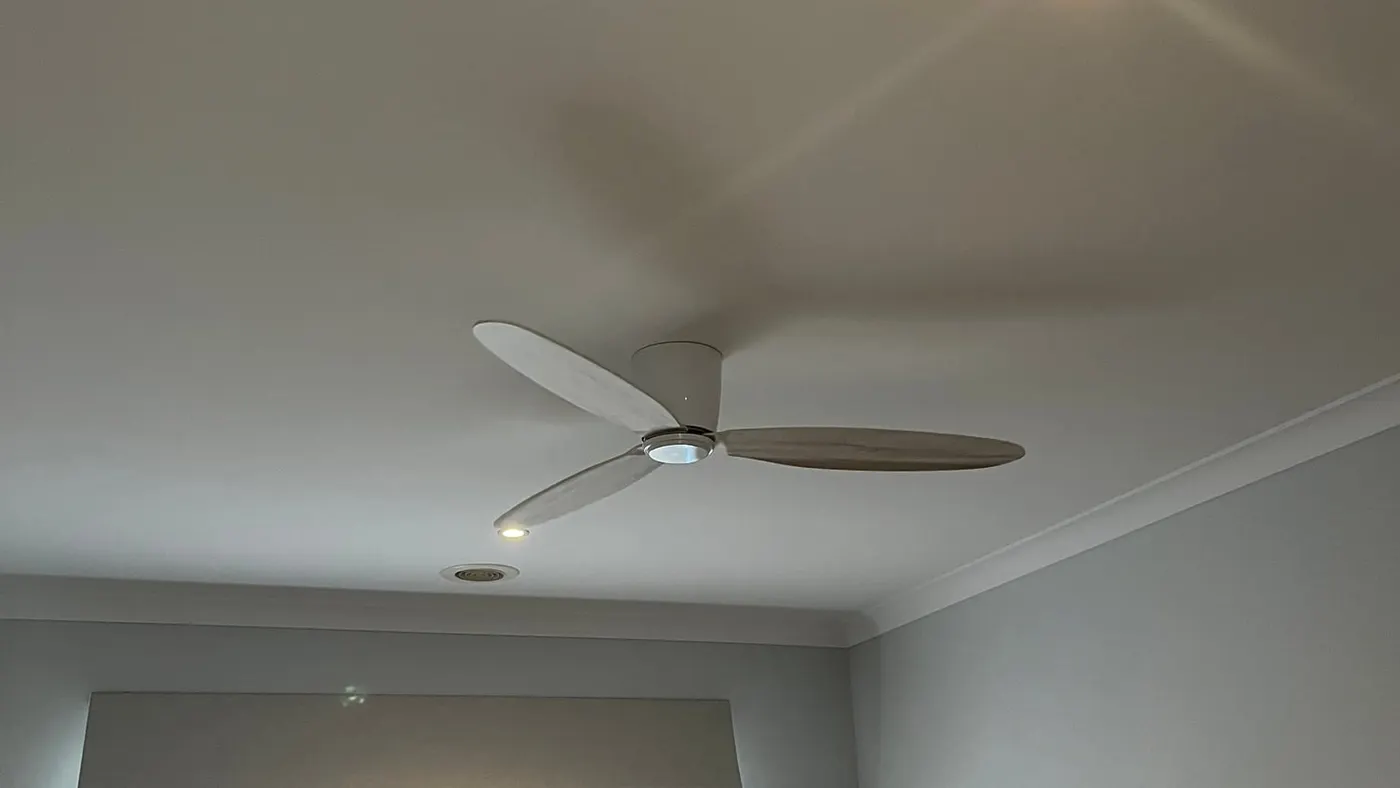
Ceiling fan rules in Victoria: do you need an electrician? Yes, for any ceiling fan that is wired into the house. Installing a new fan, swapping an old one, replacing a light with a fan or changing its wall control all alter the home's fixed wiring. In Victoria that is electrical installation work, and it has to be done by a licensed electrician working for a registered electrical contractor, even when the wiring is already there.
What you can do yourself is limited: change a globe in the fan's light kit, clean the blades and use the controls. Every fan installation should end with a Certificate of Electrical Safety in your hands.
- Who installs it
- A licensed electrician working for a registered electrical contractor
- What you can do
- Change a globe in the light kit, not the fan or its wiring
- Paperwork
- A Certificate of Electrical Safety for the work
- Our licence
- REC 30925
Ceiling fan rules in Victoria: what the law says
No Victorian rule mentions ceiling fans by name. The rules work from a definition instead. The Electricity Safety Act 1998 defines electrical installation work as the installation, alteration, repair or maintenance of an electrical installation. A hard-wired ceiling fan connects to, and changes, your fixed wiring, which is what that definition covers. So installing, replacing, rewiring or repairing a fan is treated as electrical installation work, even though the word "fan" appears nowhere.
Energy Safe Victoria (ESV), the state's electrical safety regulator, is blunt about the rest: "Electrical work isn't a DIY job, even for small jobs such as changing power points or light switches." It also says doing your own electrical work is illegal, and that it can be deadly. A ceiling fan is a bigger job than a light switch: a spinning, mains-powered fitting hanging over the room.
The law also says that electrical equipment working above extra-low voltage must be installed and connected by a licensed electrician, and that an electrician doing work for a customer must work for a registered electrical contractor (REC). A ceiling fan runs on 240 volts, so both apply.
Ceiling fan jobs: what you can do and what needs a licensed electrician
The line is simple. Anything that touches the fixed wiring is electrician work. Using the fan and changing a globe are yours.
| Job | Licensed electrician? | Why |
|---|---|---|
| Changing a globe in the fan's light kit | No | Victoria's Electricity Safety Exemptions Order exempts inserting or removing a light globe from the licensing rules. Switch off and let the globe cool first. |
| Cleaning the blades, changing the remote's batteries, using the summer and winter setting | No | This is using the fan, not working on the installation. Turn the fan off first. |
| A pedestal, desk or tower fan that plugs into a power point | No | An appliance fitted with a plug and cord by the manufacturer is exempt from the licensing rules. |
| Installing a fan where there has never been one | Yes | New wiring and a new fitting: installation work. |
| Swapping an old fan for a new one on the same wiring | Yes | The old fan is disconnected and the new one connected. A like-for-like swap is still installation work. |
| Replacing a ceiling light with a fan | Yes | The light comes off the fixed wiring and the fan goes on. |
| Fitting or rewiring the fan's light kit | Yes | Only the globe change is exempt. Wiring the kit is installation work. |
| Adding or changing a wall control, switch or remote receiver | Yes | ESV names light switches as electrical work that is not DIY. |
| Repairing a fan that hums, will not start or runs on one speed | Yes | Repair and maintenance of the installation are in the Act's definition. |
| Taking a fan down and leaving the ceiling point safe | Yes | Disconnecting it alters the installation, and the cable has to be made safe. |
The plug-in exemption does not help with a ceiling fan, because ceiling fans are normally wired to a supply point in the ceiling rather than plugged in.
Talk to a licensed Geelong electrician (REC 30925).
Can I replace a ceiling fan myself if the wiring is already there?
No, and this is the most common misunderstanding. A like-for-like swap feels like changing an appliance, but the old fan is disconnected from the fixed wiring and the new one is connected to it. That is installation work. Victoria's exemptions do not include a general one for home owners working on their own house.
Fans carry particular risks for an untrained installer:
- Live wiring at the ceiling. The circuit has to be isolated and proved dead before anything is touched, and the cables for the fan, its light and the wall control are not always arranged the way they look.
- The fixing. A fan is a moving load. It has to be fixed to solid framing, not hung from plaster or an old light batten.
- Testing. Before a certificate can be issued, the electrician must test the work, including earthing continuity, insulation resistance and polarity.
The Act covers offering the work as well as doing it. It is an offence to carry out, or offer to carry out, electrical work without the right licence, with a maximum of 50 penalty units. If a handyman offers to put up your fan, ask to see an electrical licence first. Our guide is DIY electrical work legal in Victoria? explains the wider rules, and ESV sets out its position on its don't do it yourself page.
Height, position and fixing: what your electrician checks
Many fan questions are really about where the fan can go. These are the checks a good installer makes before the fan goes up, and the ones worth thinking about before you buy:
- Blade height. The clearance between the blades and the floor matters. The fan's installation instructions set the minimum height for that model, so check them against your ceiling height before you buy. On a lower ceiling a low-profile fan, which sits close to the ceiling, keeps the blades higher. Your electrician checks the clearance on site before fixing the fan.
- What is above the ceiling. A spinning fan needs solid timber above it. Where there is no joist in the right place, a timber support is fitted between the joists.
- Sloped and high ceilings. A raked ceiling needs a mount made for the angle, and an extension rod brings a fan on a high ceiling down to where you can feel it. Check the maximum ceiling angle listed for the fan.
- Clear of other fittings. Keep the blades clear of pendant lights, tall cupboard doors and doors that swing open. A downlight directly above or beside the blades throws a strobing flicker across the walls, so plan fans and LED downlights together.
- Room size. A fan too small for the room only moves the air directly beneath it. Long rooms often work better with two fans than one large one.
- Outdoor areas. A fan under an alfresco or verandah roof should be one the manufacturer rates for outdoor use, which matters in coastal air on the Bellarine and the Surf Coast.
The Certificate of Electrical Safety for a ceiling fan
Victoria requires a Certificate of Electrical Safety for all electrical installation work, whatever the size of the job. A fan installation is no exception, so you should receive one every time.
- Tests come first. Before issuing a certificate the electrician must carry out the required tests: earthing continuity, insulation resistance, polarity, correct circuit connections, earth fault-loop impedance and safety switch (RCD) operation.
- Normally no inspector's visit. Work on the main switchboard, consumer mains or main earthing is prescribed work and must be independently inspected. ESV's examples of non-prescribed work include lighting points and power points. Fans are not named on either list, but a fan on an existing circuit does not touch the parts that trigger an inspection, so it is normally non-prescribed work.
- When your copy arrives. For non-prescribed work the Act gives the electrician one month after completing the certificate to give you your copy.
- Keep it. The electrician only has to keep a copy for three years. Keep yours with the house papers.
- If none is offered. ESV says an electrician cannot refuse to issue a certificate for any reason, including a payment dispute, and you can report a refusal to Energy Safe Victoria.
Not sure what you need? Tell us what is happening and we will talk it through.
How to check the person installing your fan is licensed
- Ask to see the licence. ESV advises always asking to see a tradesperson's licence. A licensed electrician carries an identification card endorsing them to do electrical work.
- Look for the REC number. A registered electrical contractor must include its registration number in its advertising. Ours is REC 30925.
- Search the public register. ESV's public registers let anyone look up a registered contractor or a licensed electrical worker.
- Ask about the certificate up front. ESV names a contractor who does not issue a certificate as a warning sign.
Our guide on how to find a licensed electrician in Geelong goes through each of these checks.
What affects the cost of a ceiling fan installation
We quote each fan job after seeing the room, because the same fan can be a short swap in one house and a longer job in the next. What makes the difference:
- Wiring at the spot. Swapping a fan, or replacing a centre light with a fan and light, uses the power already there. A new position needs new cable run from a suitable circuit.
- Roof access. An open roof space is quicker. A flat roof, a second storey above or a tight roof space all add time.
- Controls. A remote-controlled fan with a light can often run from the existing switch cable. Separate wall controls for the fan and the light usually mean an extra cable down the wall.
- Support. Whether a timber support has to be fitted between the joists.
- Ceiling height and slope. Extension rods, angled mounts and working at height.
- How many fans. Several fans in one visit is more efficient than one at a time.
- Who supplies the fan. You can buy your own or we can supply one.
What to do next
Planning a new fan: check the room size, compare your ceiling height with the fan's installation instructions, and decide between a remote and a wall control. Then book a licensed electrician to fit it. If an existing fan wobbles more each week, hums at the wall control or stops on one speed, switch it off and have it checked rather than running it until it fails. A burning smell or scorching at the fan or its control is urgent: switch it off and call our 24/7 emergency electricians.
CabledIN's licensed electricians (REC 30925) install, swap and repair ceiling fans across Geelong, the Bellarine Peninsula, the Surf Coast and Golden Plains, with a lifetime workmanship warranty and a Certificate of Electrical Safety on every job. See ceiling fan installation in Geelong for fan types, sizes and controls, or call 1300 025 555.
Frequently asked questions
Do you need an electrician to install a ceiling fan in Victoria?
Yes. A hard-wired ceiling fan is part of your home's fixed wiring, and installing, replacing or rewiring one is electrical installation work for a licensed electrician working for a registered electrical contractor. You should receive a Certificate of Electrical Safety when it is done.
Can I replace a ceiling fan myself if the wiring is already there?
No. A like-for-like swap still disconnects and reconnects the fixed wiring, which is installation work. Energy Safe Victoria says electrical work is not a DIY job, even for small jobs such as changing a light switch.
Can I change the light globe in my ceiling fan myself?
Yes. Inserting or removing a light globe is exempt from Victoria's electrical licensing rules. Switch off and let the globe cool first. Fitting or rewiring the light kit itself is electrician work.
Is it legal for a handyman to install a ceiling fan in Victoria?
Only if they hold an electrical licence and work for a registered electrical contractor. The Electricity Safety Act makes it an offence to carry out, or offer to carry out, electrical work without the right licence.
How high does a ceiling fan need to be above the floor?
The minimum blade height for each fan is set in the manufacturer's installation instructions, so check them against your ceiling height before you buy. Low-profile fans suit lower ceilings, and your electrician checks the clearance before fixing the fan.
Do I get a certificate for a ceiling fan installation?
Yes. Victoria requires a Certificate of Electrical Safety for all electrical installation work, whatever its size. For non-prescribed work, which a fan installation normally is, your copy is due within one month.
Can a ceiling fan replace a ceiling light?
Yes, it is one of the most common fan jobs. The fan uses the power at the light point, a solid support goes in above the ceiling, and a fan with a built-in light keeps the room lit. It is a job for a licensed electrician.
Still have a question? Ask the CabledIN team.