
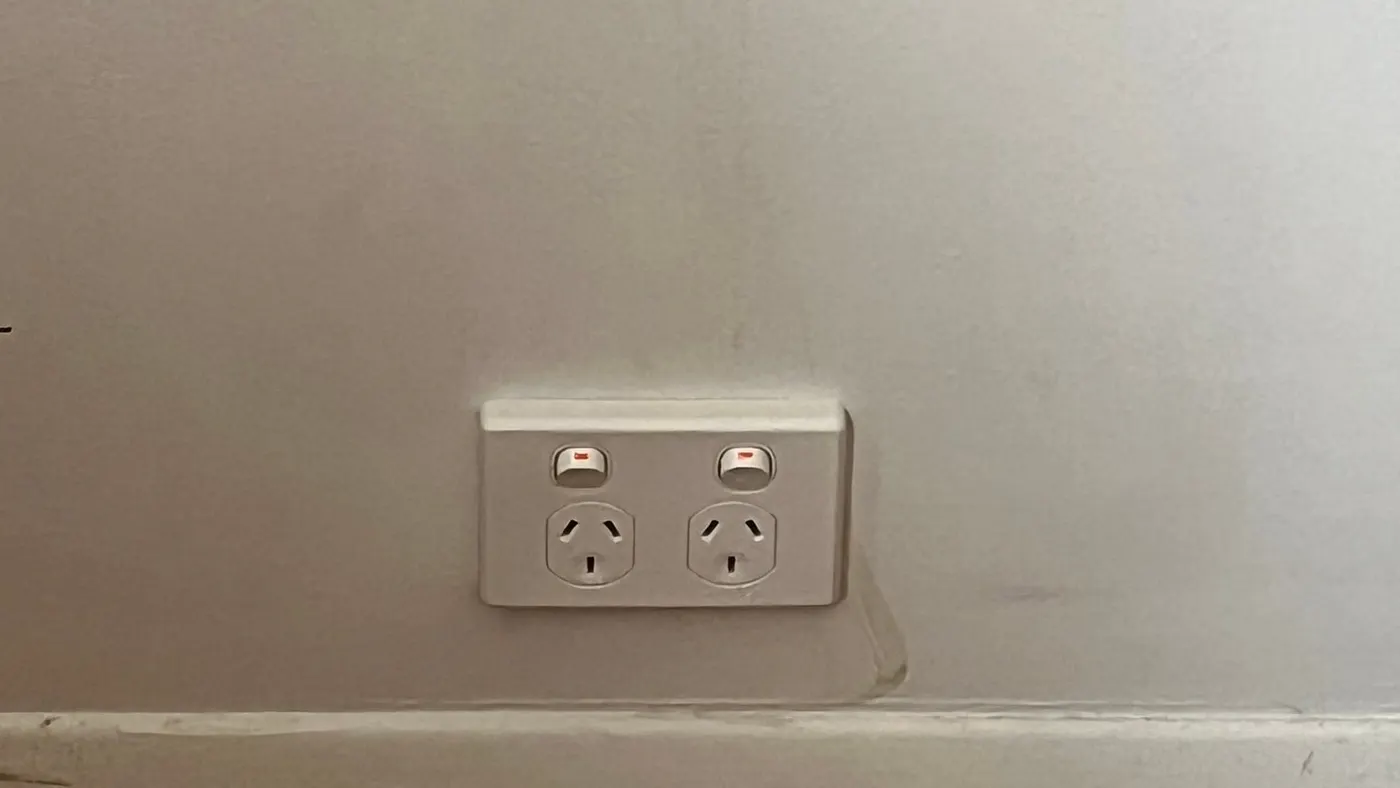
Can an electrician install a power point anywhere? Almost anywhere in a home. A licensed electrician can add or move a power point on most walls, benches, garages, sheds and outdoor areas. The firm limits are near water and cooking: the Wiring Rules keep power points away from the bath and shower, and Energy Safe Victoria says no socket may sit within 150 mm of the edge of a cooking surface.
The other limits are practical: the wall, the cable route, the load on the circuit and room in the switchboard. Wherever it goes, it is licensed work. You cannot add or move a power point yourself in Victoria.
- Short answer
- Almost anywhere, with firm limits near water and cooktops
- Kitchens
- No socket within 150 mm of the edge of a cooking surface (Energy Safe Victoria)
- Who can do it
- A licensed electrician working for a registered electrical contractor
- Paperwork
- A Certificate of Electrical Safety, however small the job
Where a power point can go, room by room
This table sums up where an electrician can put a new power point in a typical home, and what decides it. The sections below explain the rules behind each row.
| Where you want it | Can it go there? | What decides it |
|---|---|---|
| Bedrooms, living areas, hallways, a study | Yes, on almost any wall | How a cable can reach the spot, and the load already on the circuit |
| Kitchen bench and splashback | Yes, with one firm limit | No socket within 150 mm of the edge of a cooking surface |
| Inside a pantry or appliance cupboard | Usually | What will run there, and how the cable gets in |
| Behind a wall-mounted TV | Yes | The wall construction and where the bracket sits |
| Bathroom | Only in some positions | The Wiring Rules zones around the bath and shower |
| Laundry | Yes, with care near the tub | Distance from water and what will be plugged in |
| Deck, patio, pergola or garden wall | Yes | An outlet made for outdoor use, as sheltered as the spot allows |
| Attached garage or detached shed | Yes | How power gets out to the building, and whether it needs its own circuit |
For a television on the wall, see TV wall mounting and installation, where the power point and the bracket are planned together.
Who is allowed to add or move a power point in Victoria
Only a licensed electrician working for a registered electrical contractor (REC). Victoria's Electricity Safety Act 1998 defines electrical installation work as the installation, alteration, repair or maintenance of an electrical installation. Adding a power point, moving one and swapping an old one for a new one all count.
Energy Safe Victoria (ESV) puts it plainly: "Electrical work isn't a DIY job, even for small jobs such as changing power points or light switches." Our guide is DIY electrical work legal in Victoria? explains what the law does and does not let a home owner do.
- A certificate every time. A Certificate of Electrical Safety must be provided for all electrical installation work, whatever the size of the job, including a single power point.
- No inspector needed. Power points are non-prescribed work, so an independent inspector does not have to attend. Your copy of the certificate is due within one month.
- Check who you hire. ESV advises always asking to see the electrician's licence, and anyone can look up a contractor on ESV's public register. Ours is REC 30925. Our guide on how to find a licensed electrician in Geelong covers the checks.
Talk to a licensed Geelong electrician (REC 30925).
Power points in bathrooms and other wet areas
Bathrooms are where "anywhere" stops. The Wiring Rules (AS/NZS 3000), the national standard that Victoria's electrical safety regulations call up, divide the space around a bath or shower into zones. The closer a zone is to the water, the less can go in it.
- Closest to the bath or shower: no power points at all.
- The next zone out: only limited options, such as a shaver outlet, or a power point protected by a safety switch (RCD) and placed inside a cupboard.
- Further out: a power point is possible, but it has to sit above a minimum height off the floor and have extra protection, such as a safety switch.
Light switches and other fittings have similar limits. The zones depend on the layout of your bath, shower and room, so the electrician works them out on site. Tell them what you want to plug in, such as a hair dryer or a toothbrush charger, and they will show you where it can go.
Two more pieces of ESV advice apply in wet areas. Do not use extension leads or power leads there unless they are made for wet use. And do not use a portable heater in the bathroom: ESV suggests a high-mounted strip heater or a ceiling unit installed by a registered electrical contractor instead, which is the work on our bathroom heater installation page.
Power points in the kitchen
Kitchens need more power points than any other room, and most bench positions are fine. The firm limit comes from Energy Safe Victoria: no switch or socket may be within 150 mm of the edge of a cooking surface. ESV also says every cooking appliance with an open cooking surface, induction cooktops included, needs an isolating switch that is visible and readily accessible, should be within 2 m, and is not mounted on the appliance itself.
Beyond that, a good kitchen layout is about what you plug in:
- Bench appliances such as the kettle, toaster and coffee machine, spread across more than one double power point so they are not all running off one adaptor.
- A power point inside the pantry or an appliance cupboard for the microwave or air fryer, so they stay plugged in out of sight.
- Points for the fridge and dishwasher placed where you can reach the plug when the appliance has to come out.
- Heavier appliances such as a wall oven or cooktop, which are usually wired on a circuit of their own. See oven and cooktop installation.
Outdoor power points, garages and sheds
Outdoor power points are common on decks, patios, pergolas and garden walls, and an electrician can put one in most of those places. The choice that matters is the outlet. We fit outlets made for outdoor use, not an indoor power point under a cover, and place them where they are sheltered from rain and sprinklers as far as the spot allows.
A fixed outdoor point also stops leads being run across the yard. ESV's outdoor safety advice is never to use a portable electrical appliance or place an extension cord where it could be splashed or fall into a pool.
Garages and sheds are just as common. An attached garage can usually be fed from a circuit in the house. A detached shed or garage needs power run out to it, often as a cable laid underground between the buildings, and if you plan to run power tools, a fridge or a heater out there it may need a circuit of its own from the switchboard. The electrician plans the cable route with you before any digging starts.
If you want lights outside as well, outdoor lighting installation can be done on the same visit.
Not sure what you need? Tell us what is happening and we will talk it through.
What limits where a power point can go in your home
Most of the time the limit is not a rule. It is the building.
- The wall. Plasterboard on a timber frame is the easiest. Brick and double-brick walls make a flush power point harder, and a neat surface-mounted outlet or a short run of cable cover can be the better choice.
- The cable route. The electrician has to get a cable from an existing circuit, or from the switchboard, to the new spot. A roof space, or a timber floor with room underneath, makes that easy. A concrete slab, a flat roof or a second storey can mean a longer route.
- The circuit. An existing power circuit can often take another outlet. If it already trips when a few appliances run together, more outlets on that circuit will not help, and a new circuit is the answer. Our circuit breaker repairs page covers tripping on an overloaded circuit.
- The switchboard. A new circuit needs a spare space in the switchboard. A full or old board may need a switchboard upgrade first.
- Safety switch protection. Before adding outlets, the electrician checks whether the circuit is protected by a safety switch, and talks to you about it if it is not.
More power points or more adaptors?
Double adaptors and power boards in every room are a sign a home needs more power points. ESV's home safety advice is to use a power board with a built-in safety device, and to avoid piggybacking adaptors, one plugged into another.
A power point that is already damaged needs attention too. ESV says not to touch or try to repair a loose, cracked or broken power point: cover it, stop using it and have a licensed electrician replace it. Warmth, scorch marks, crackling or a plug that keeps falling out are all reasons to call. If a faulty outlet keeps cutting the power, our guide why does my safety switch keep tripping? explains the other causes.
How to plan new power points, and what changes the cost
A short plan before the electrician arrives gets the points in the right place the first time.
- List what you will plug in, room by room. Count chargers, lamps, the TV and its equipment, the computer and any heater. A phone charger and a heater put very different loads on a circuit.
- Mark the spots. Think about where the furniture will sit. A power point hidden behind a bed head or a couch is one you will not use.
- Choose the height and type. Bench height in a study or workshop, USB charging beside beds, and a double rather than a single wherever you are unsure.
- Bundle the jobs. Several power points in one visit take less time per point than one at a time.
We quote after seeing the job. What changes the time and the cost is whether it is a replacement or a new point, how far the cable has to travel, how easy the roof space, floor or wall is to get into, whether a new circuit is needed, and whether the switchboard has room for it. A power point in a detached shed, or at the end of a long outdoor run, takes the most work.
What to do next
Work out where you want the power points and what you will plug into them, then call CabledIN on 1300 025 555. A licensed electrician (REC 30925) looks at the room, the circuit and the switchboard, tells you what can go where, and quotes before any work starts. Our power point installation page covers new, extra, double, USB, outdoor and replacement power points across Geelong, the Bellarine and the Surf Coast.
Frequently asked questions
Can an electrician install a power point anywhere?
Almost anywhere in a home. The firm limits are near water in bathrooms, where the Wiring Rules restrict outlets, and beside cooktops, where no socket may be within 150 mm of the edge of the cooking surface. Wall type, cable access and circuit capacity also decide what is practical.
Can you put a power point in a bathroom?
Yes, in some positions. The Wiring Rules divide the room into zones around the bath and shower: none closest to the water, only limited outlets in the next zone, and outlets with extra protection above a minimum height further out. The electrician works out the zones in your room.
How close can a power point be to a cooktop?
Energy Safe Victoria says no switch or socket may be within 150 mm of the edge of a cooking surface. That includes induction cooktops.
Can I move a power point myself?
No. Moving a power point is an alteration to the electrical installation, which is licensed work in Victoria. It must be done by a licensed electrician working for a registered electrical contractor, who gives you a Certificate of Electrical Safety.
Can you install a power point outside?
Yes. Decks, patios, pergolas and garden walls are common spots. We fit outlets made for outdoor use and place them as sheltered from the weather as the position allows.
Can you put a power point in a shed or detached garage?
Yes. Power has to be run out to the building, often by an underground cable, and a shed with power tools, a fridge or a heater may need its own circuit from the switchboard.
Do extra power points need a new circuit?
Not always. An existing power circuit can often take another outlet. If the circuit already trips when several appliances run together, or the outlet is for a heavy appliance, a new circuit from the switchboard is the better answer.
Is it safe to use double adaptors instead of more power points?
Energy Safe Victoria advises using a power board with a built-in safety device and avoiding piggybacking adaptors. If every room relies on adaptors, more power points are the safer fix.
Still have a question? Ask the CabledIN team.